MARIANI’S
Virtual Gourmet
NOVEMBER
1, 2026
NEWSLETTER
Founded in 1996
ARCHIVE
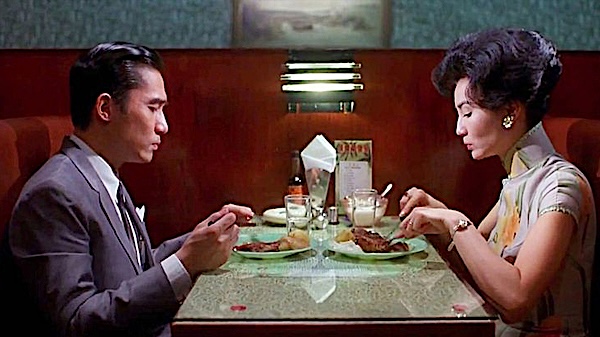
Tony Leung Chiu-wai and Maggie Cheung in "In the Mood for Love" (2000)
❖❖❖
THIS WEEK
EIGHT GREAT REASONS
TO HEAD FOR NASHVILLE
By John Mariani
NEW YORK CORNER
AMERICAN CUT
By John Mariani
PEARL
CHAPTER SEVEN
By John Mariani
GLUTTONY
Chapter Four
By John Mariani
NOTES FROM THE WINE CELLAR
SOME GREAT REASONS
TO HEAD FOR
NASHVILLE
By John Mariani

It was only a decade or so ago that
Nashville would not have ranked among
America’s 25 greatest cities. True,
it’s long been dubbed by its promoters as
Music City USA, but a lot of that was hype,
with more country music stars living in L.A.
and playing Vegas and the Iowa State Fair
than the Grand Old Opry. 
But that has largely changed, not least
because it has capitalized on its Music City
USA moniker, and the renovation and
beatification of the Opry has been the
ballast. Now Nashville is home to The
Pinnacle concert hall with 4,500-person
capacity; Category
Ten, a multi-level live music venue
with plenty of line-dancing; Honky
Tonk Central on three floors; and Nissan
Stadium, seating 69,000 Tennessee
Titans fans as well as hosting superstars
like Taylor Swift and Bruno Mars. The big names—Brad
Paisley, Keith Urban, Vince Gill,
Miranda Lambert, Alison Krauss and plenty
more—are playing regularly in town, and
Broadway now teems with new bars, restaurants
and nightclubs. Even
if you took all that away, the city still has
some grand old reasons to visit and eat.
 Country
Music Hall of Fame and Museum—Since its grand
opening in 2001, the CMHFM has evolved into
the most exhaustive and well-mounted music
museum in the country—more exciting and
enticing than Seattle and Cleveland’s Rock and
Roll Halls of Fame put together. Archives,
videos and special
 exhibits cover
two centuries of American country music, from
Jimmie Rodgers “the Singing Brakeman” to Doc
Watson, from the Everly Brothers to Charley
Pride. Just to view the collection of vintage
guitars—including Les Paul’s 1941 “electric
log” and Hank Williams’ Martin D-28––and 600
other instruments is reason enough to visit.
Then there’s the vital oral history project,
the moving image and recorded sound collection
of 200,000 recordings, and 800 stage costumes,
from Dolly Parton’s sequins to Nudie Cohen’s
spangly get-ups for Porter Wagoner. It’s
worth the admission price just to gawk at
Elvis’ "Solid Gold"
Cadillac with its own 45rpm record player,
refrigerator, cocktail dispenser, electric
shoe buffer and six 24k gold-plated records
attached to the ceiling.
RCA Studio B—An adjunct tour
of the Museum, the historic Studio B was
founded by Chet Atkins, where he created
revolutionized music with the “Nashville
Sound” of background vocals and strings for
every artist from Roy Orbison and Jim Reeves
to  Johnny Cash
and Conway Twitty; Presley recorded 150
records here.
Opened in 1957 and costing $37,515,
Studio B is both crucible and shrine, left
just as it was when it closed in the
mid-1970s, the old tape decks and sound
buffers still in place, the Hammond organ
there and Shure 555 microphones whose sound
quality has never been matched. And you can
still see the dent in the building where Dolly
Parton, on her way to record her first record
here, jumped a curb and smashed into the
outside wall.
The Hermitage Hotel—This year celebrating
its 110th birthday, The Hermitage has been
restored 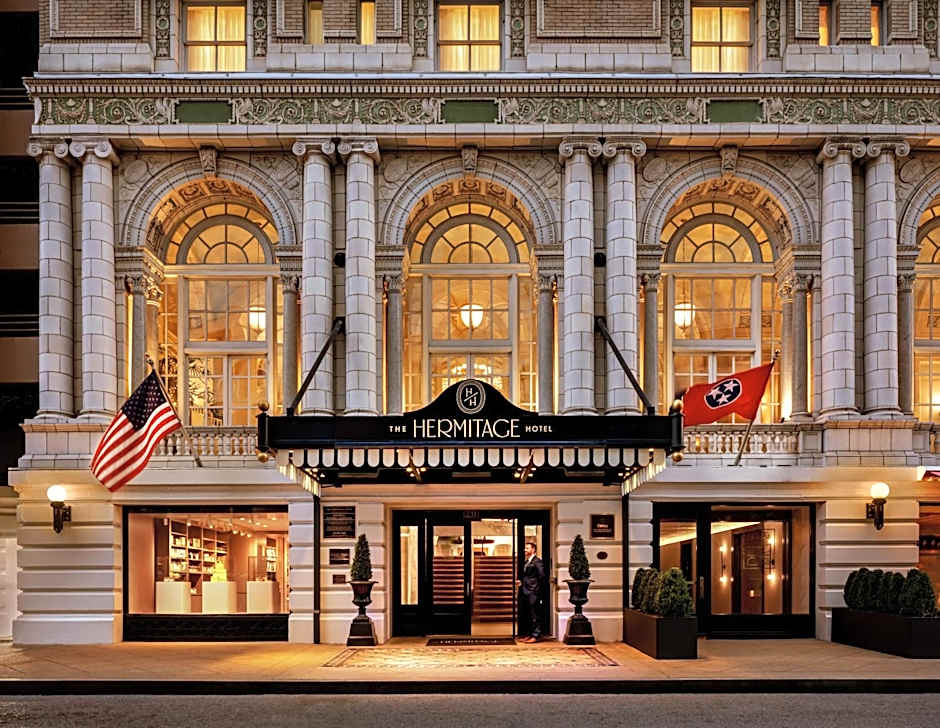 to a
magnificence no other landmark hotel in
America can currently claim, bringing its
Siena marble entrance hall and stained glass
lobby ceiling into pristine focus once again.
The wonderful Oak Bar is still intact, where
you can sip a custom-made single barrel Jack
Daniel’s Tennessee Whiskey made for the hotel,
until the supply runs out, as is the Drusie
& Darr subterranean dining room, whose
menu is now under Jean-Georges Vongerichten,
with an eclectic mix of pastas, pizzas and
fried chicken. The room was here in 1940
a Tennessee newcomer named Dinah Shore debuted
the song “Near You.” And
everyone needs to pay a visit to America’s
finest Men’s Room, an art deco marvel of green
and black tiles—once in danger of being
demolished. Women are allowed to sneak a peak
too.
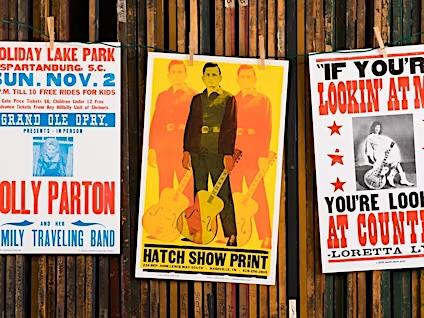
Hatch Show Print. Since 1879 this print
shop has been designing the totemic posters
for music entertainers and events, including
just about every poster hung in the Ryman
Auditorium over the last century. Cab
Calloway, Earl Scruggs, Willie Nelson, Patsy
Cline, Neil Young, Bob Dylan—all have had
Hatch make their posters, and visiting the
place is to see the array, the ancient
typographic wooden fonts and the printing
presses that are part of American graphic
history. You can have one made up for
yourself, and they do wedding invitations,
too.
Arnold’s Country
Kitchen. The
“meat-and-three” is a Tennessee tradition of
serving a portion of meat 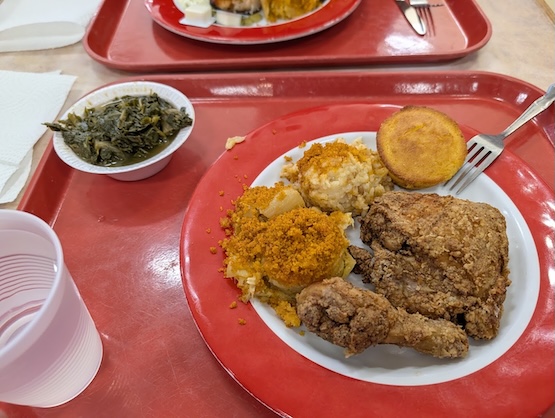 with three
vegetables on a plate, and at Arnold’s, now
three decades old, you won’t know where to
start as you slide your tray along the
cafeteria-style counter. Maybe the fried
chicken with spinach, mashed potatoes and
gravy, and red beans. Or
maybe the sliced pork with green beans, okra,
and fried green tomatoes. Then there are
desserts from apple pie to Dixie banana pie.
Bring it all to your table, sit down with some
locals—who range from banking execs and
athletes to truckers and construction
workers—sip some pre-sweetened iced tea poured
from a pitcher, and check out the autographed
photos on the walls.
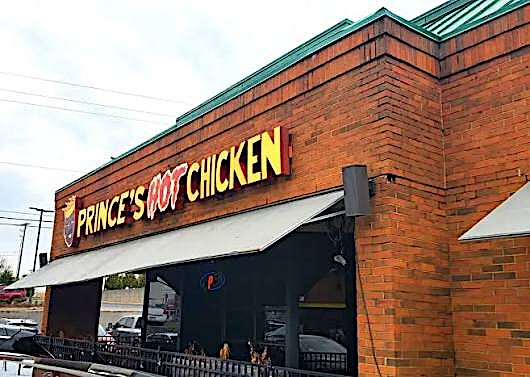
Prince’s Hot Chicken. Plenty of
Nashvillians admit to being addicted to
Prince’s Hot Chicken and others will drive a
hundred miles to get it. More
than one couple has wolfed it down then got
shagged outside in their cars. If
you’ve never been to Prince’s, think real hard
before going straight for the “very hot” (the
“mild” is hotter than most you’ve ever had and
“hot” is incendiary on the palate), because
you’re going to have a major mouth burn, tears
dribbling out of your eyes, a runny nose,and a
face as red as the cayenne pepper doused onto
this crunchy, juicy fried chicken. (This is a
very
serious commitment to your digestion.) As
owner André Prince Jeffries tells it, her
uncle was a womanizer who came home way too
late. One night, he asked his ladyfriend for
something to eat, so she tried to punish him
by making his chicken so hot that he’d learn a
lesson. Except
the guy loved it, served it to his friends,
and Prince’s Hot Chicken was born. There are
now three branches, including one at the
airport.
3rd & Lindsley Bar
and Grill, with a capacity for
700,has nightly music sessions, and most
famous of them is the Monday night jam
(previously held at the Station Inn)
with the fabulous
The Time Jumpers appear—a country swing
group of Nashville’s finest studio musicians,
guys who have recorded with everybody from Reba McEntire and Robert Plant to
Norah Jones and Kings of Leon.
 Jack
Daniel's Distillery––Since 1866 the
quintessential Tennessee
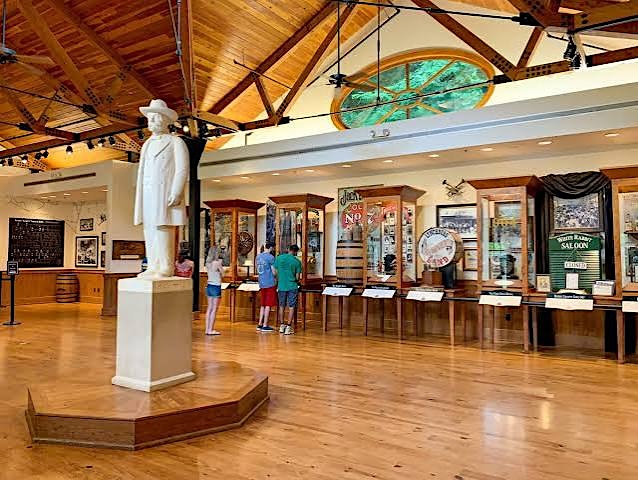 Whiskey is made out
in Lynchburg, and there are several tours
that go out there and include lunch at Miss
Mary Bobo's Restaurant (here since 1908),
serving Southern fried chicken, boarding
house meatloaf, fried catfish, country-style
barbecued ribs, mac & cheese, cornbread,
chess pie and buttermilk pie served with
Jack Daniels whipped cream.
❖❖❖
NEW YORK CORNER
AMERICAN CUT
363 Greenwich Street
212-226-4736
By John Mariani
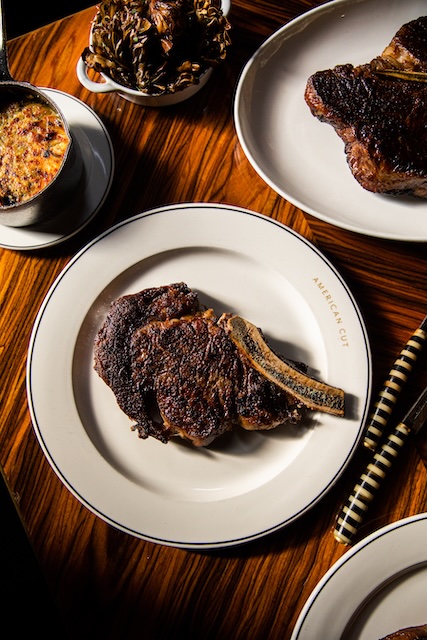
Steakhouses are a lot like
opera, in which the music and libretto don’t
change much but the production, design and the
quality of the singers do. So, too, steakhouse
menus do not differ a great deal from one
another––principally because people expect them
to carry the same ever desirable dishes––but the
design, atmosphere and quality of the food do.
 Not
all high-end steakhouses buy their meat and
ingredients from the same purveyors or even have
the same way of cooking the food. Some use
infrared broilers, others upright deck broilers,
others wood fire grills, others gas char-broilers
to cook their steaks. Some use cast-iron skillets.
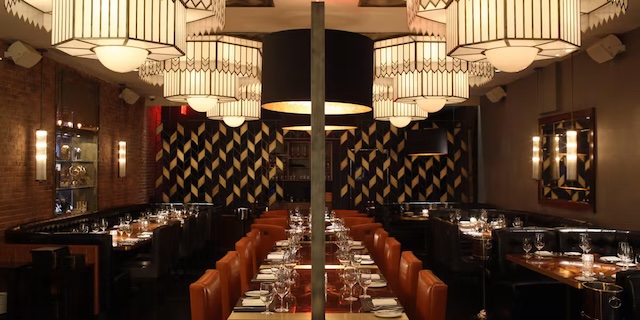
Case in point among those
diverging from the crowd is the twelve-year old
American Cut New York Cut in TriBeCa, which, with
its red brick walls, geometric wallpaper and huge
Mother Ship chandeliers not only looks unlike most
steakhouses but serves a menu of dishes not found
on any others’. I had not been back to this
address since it opened under Marc Forgione, who
heavily promoted wagyu beef and has since gone
elsewhere. Now, under LDV Hospitality, it’s a
much more diverse restaurant, with a
highly professional staff led by manager Chris
Sileo and a kitchen, under exec chef Juan-Pablo
Perez, that manifests a very high degree of
consistency throughout the menu. 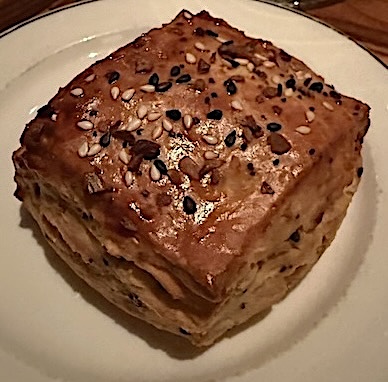
Having now returned after a
dozen years, I found the place bustling on a
Tuesday night. Given its largely male
clientele––guys from Wall Street who hang their
jackets over the back of their chairs––the main
dining room can be loud, but the lounge and a
small room to its rear, are less so. After 9 PM on
weekdays the place starts to empty out.
As noted, steakhouse menus
must compete in regard to the staples, but in so
many cases American Cut offers an array of
specialties (nightly appended) that make it quite
special, starting off with a terrific 3-inch-high
well herbed and very crispy biscuit (right)
along with flavored butter.
 Even within the staples, a
small touch is added to distinguish a dish, like
the finally chopped steak tartare. That is topped
with a sunny side up egg, rather than mixed into
it, and a dollop of Chinese caviar. The
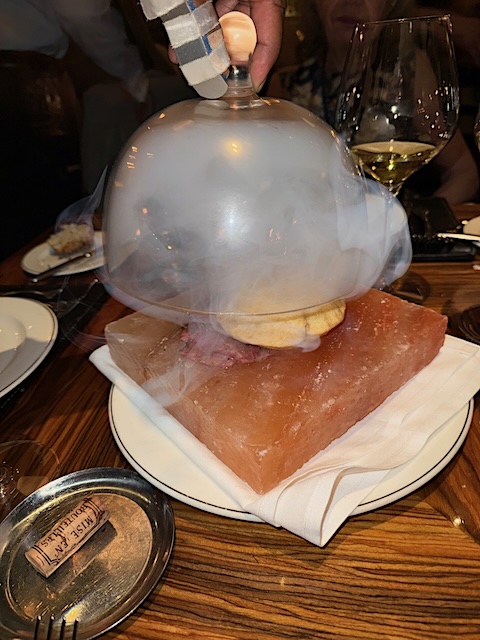
ceviche service for two is a showpiece: A
smoke-filled glass cloche is lifted and the raw
fish is to be dragged across a square block of
pink Himalayan salt, then put into a morsel of
pita. And with an order of half-a-dozen oysters,
there was the lagniappe of adding a seventh.
Really good was a dish they’ve made their own, the
chili lobster on Texas toast that has some real
snap to it. Bone marrow, which you can find
elsewhere, here, gets the addition of snails with
a James Beard salad and grilled bread.
There are the usual cuts of beef, from
an American wagyu strip to a T-bone, filet
mignon and ribeye, and of particular interest was
a pastrami ribeye with whole grain mustard.
Braised short ribs are slowly cooked
in a reduction of Cabernet Sauvignon wine till the
meat falls from the bone. Rack of lamb––four thick
chops––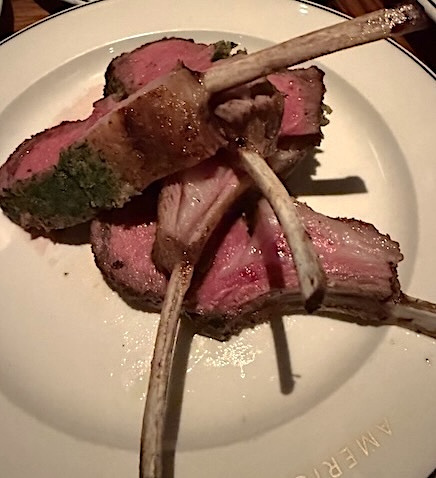 is
encrusted with herbs and pine nuts
Some steak houses seem
reluctant to treat seafood with the same respect
as they do beef, but the halibut at American Cut
with cauliflower and golden raisins was one of the
best I’ve had of this mild fish that always needs
a bit of help to shine.
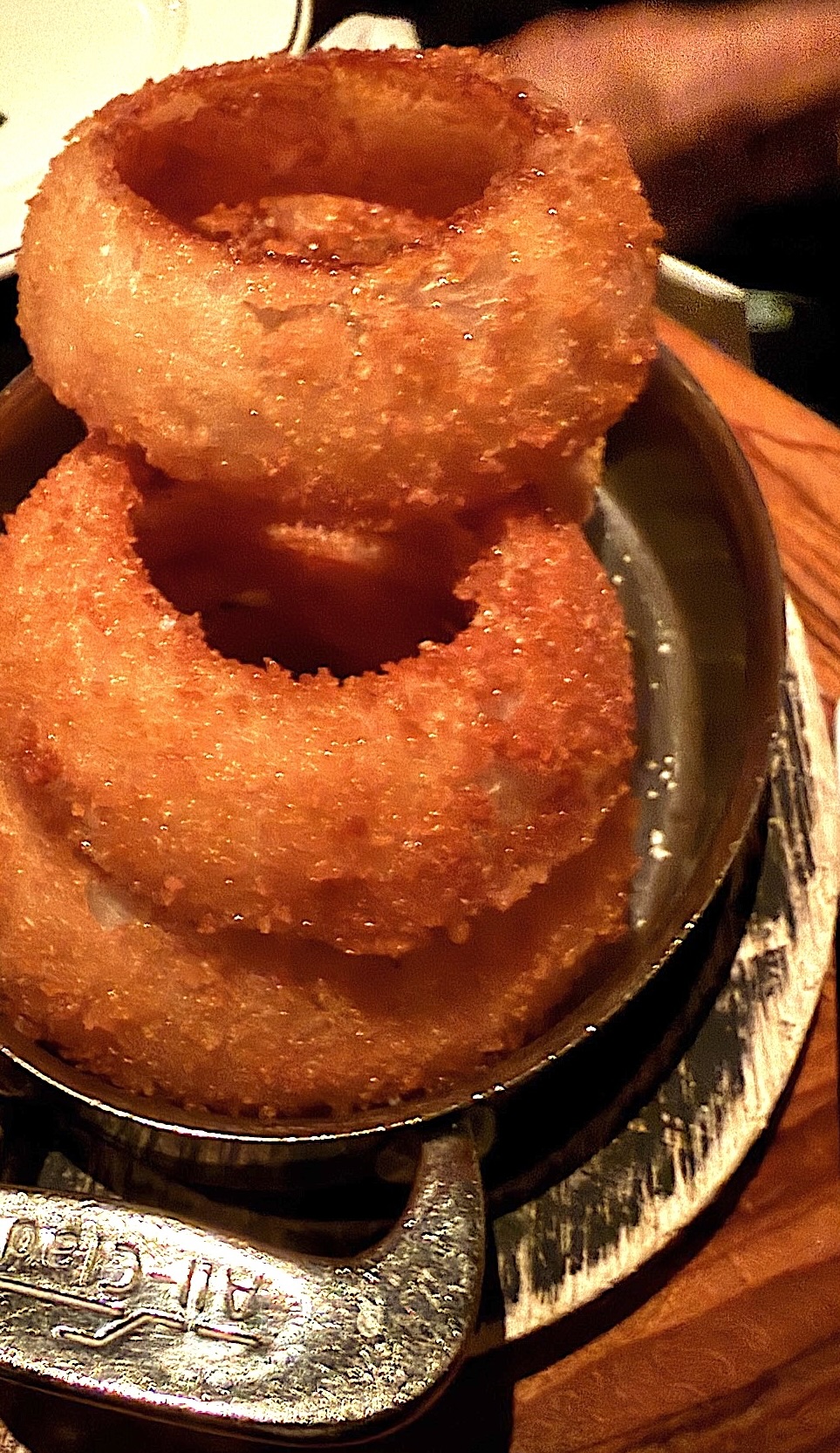 The
onion rings have obviously been perfected after
years of trial and error, so that they are big,
fat and of uniform size, perfectly crisp, and
sweet. Another example special items here is the
jalapeño-studded mashed potatoes, and a casserole
of housemade cavatelli pasta,
mac-and-cheese with either truffles. Creamed
spinach has a pleasing note of nutmeg in it.
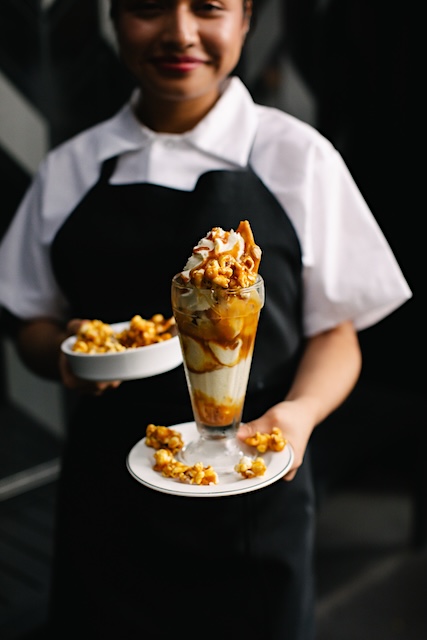
Desserts follow the usual
line with a flowerless chocolate mousse and a very
good strawberry cheesecake, but you may want to
try the out-of-the-ordinary Cracker Jack sundae
with caramel popcorn, peanut brittle and popcorn
ice cream.
It should be mentioned that
in the bar lounge the shorter, lighter menu
goes beyond the usual, with wagyu sliders and
bourbon onions with beer cheese; a crab cake
sandwich on a brioche bun with smoked onion
remoulade; ribs of cold 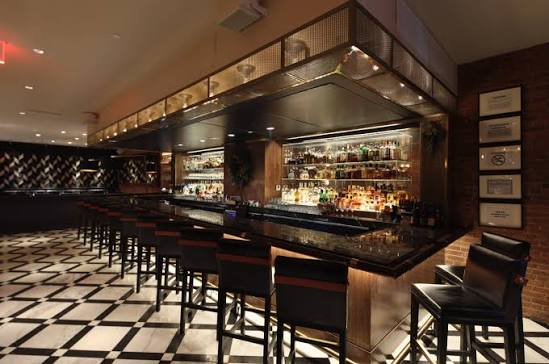 smoked
pork with barbecue sauce; and another signature
item, the lobster roll Maine style with chips.
The wine list at American
Cut ranks at the level of the city's better
steak houses, very deep and broad, favoring red
wines, and although I did not check out everything
on it, markups seem to be a bit less than at the
usually hikes.
 There are many reasons
people choose one steakhouse in New York over
another––some out of historic interest, like Gage
& Tollner; some for its sports theme, like
Gallagher’s; some out of habit, like Smith &
Wollensky', some for location, like Wolfgang’s,
and some for swank, like La Tête d’Or. They all
compete for the best beef––and New York always
gets the best of the best––but many play it safe
and shy away from anything that has not been
sacrosanct. American Cut is selling what everybody
else does, but its additions and embellishments
give every good reason to make it a destination.
Dress: American Cut "asks our guests
to dress with style and intention—think
polished, professional, and sophisticated. While
we encourage individual expression, we kindly
request that guests avoid athletic-wear,
beachwear, flip-flops, shorts, hoodies,
excessively distressed denim, and overly casual
attire."
PEARL

The
Mysterious Death of Janis Joplin
By John Mariani
CHAPTER SEVEN
Houseman lived in
an enclave of houses that, in the typical
style of 1960s Long Island development, were
of a cookie-cutter sameness: Low-slung,
aluminum siding on the second floor, red brick
below, small front yard, with an attached
two-car garage.
Katie and David rang the doorbell and
were greeted by a stout woman looking about
seventy-five, hobbling a bit.
“You must be those cop friends Richard
said were coming. He’s been looking forward to
lunch at Luger’s.”
 “That’s for
sure,” said a tall, bald, heavy-set figure
wearing an overcoat coming towards them using a
metal cane. “You must be Katie, read a lot of
your stories. Exciting stuff. And David, I
admired your work both on and off the force. Not
many of us cops have much of a life after
retirement.”
They shook hands and the visitors were
expecting to be invited to sit down, but Richard
Houseman said, “Well, you mind if we get going?
We can talk on the way over.”
David had driven his old Toyota Corolla
for the day because Katie’s Fiat was
not made to seat three adults. They helped
Houseman into the front seat, and he said,
“Luger’s close. Turn left at the light. I’ve
only actually been there twice, years ago, so Im
looking forward to this lunch.”
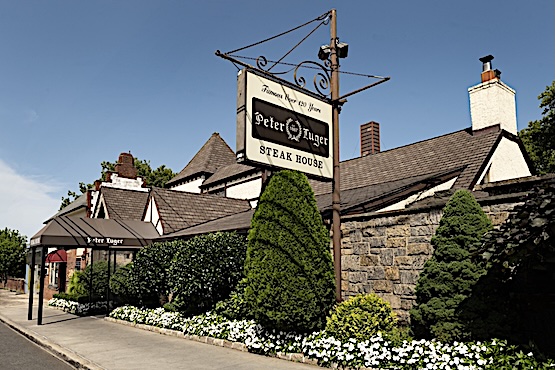
The drive to Great Neck was less than ten
minutes and they were able to park on the
street. The building rambled towards the rear,
white with shingled roof, doorway awning, with
casement windows
and set-in timbers to give it the vague
look of a German tavern. Inside those decorous
elements were repeated, with rough-hewn floors
and a medieval-looking tapestry above an unused
fireplace.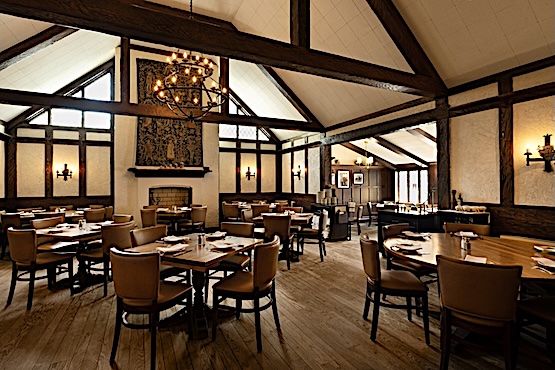
Houseman had made a reservation, and,
with the usual lack of any enthusiasm
characteristic of Peter Luger, they were shown
to a square table. “Waiter’ll be right over,”
said the manager over his shoulder.
“They’re gonna give us a menu,” said
Houseman, “but then the waiter will just ask you
how you want your steak, since that’s all
anybody ever comes here for.”
Despite a
menu listing broiled chicken and grilled salmon,
every table in the place seemed to have ordered
a steak for two or more. Houseman suggested they
start with an order of the sliced tomatoes and a
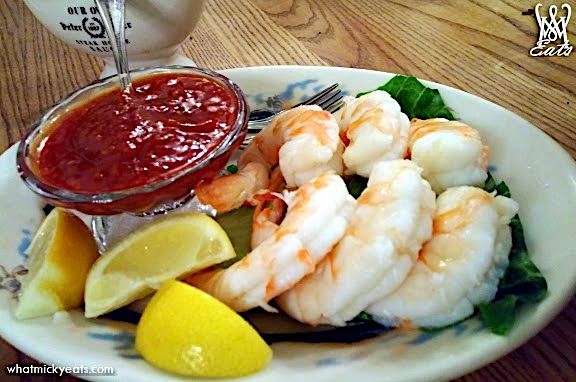
shrimp cocktail.
“I don’t drink wine,” he said, “but I
don’t think there’s much of a wine list anyway.”
“Beer’ll be fine,” said David. Katie
ordered iced tea.
Almost immediately the sliced tomatoes
with onions and the shrimp cocktail hit the
table, both very cold.
The two ex-cops talked shop for a couple
of minutes—did you know this one and that one?
So-and-so still alive? Anecdotes about Rudy
Giuliani—then Houseman said, “So, you wanna talk
about Sid Vicious’s death, right? I was there.
First cop in. I remember, it was Room 100. His
mother—who I could see right away was a
junkie—was crying or ranting like a banshee. Had
to try to calm her down more than once. There
were a bunch of other people who’d crowded the
apartment, and I told the other cops who arrived
to get them out of the bedroom but keep them for
questioning.”
 “Who were those other people?” asked
David.
“Gawkers, a few hotel guests trying to
find what all the commotion was, a couple of
Vicious’s friends, all of them looking stoned
out of their minds, some of them you could see
the track marks on their arms. Whaddaya think of
the tomatoes and shrimp?”
“Pretty cold,” said David. “Not much
taste.”
Houseman sipped his glass of beer, as
Katie took her notes. She hadn’t asked if she
could record Houseman because he’d said he might
want to keep a lot off the record.
“Vicious—what kinda stupid name is
that?—looked exactly like you’d think a dead
confirmed druggie would. Skinny as a rail, his
skin white as a sheet, eyes rolled back in his
head, track marks in both arms, and stinking to
high heaven. Not the first time I’d encountered
that. When you see these kids you never
know if you should
be disgusted or feel sorry for them.
Especially those who had made more money than a
whole precinct of cops.”
“What happened then?” asked Katie.
“The more questions I asked the more I
felt something was not right. Vicious
gets out of jail, goes to a party on Bank
Street, everyone has dinner, goes back to the
Chelsea Hotel, then everyone starts doping up,
including Vicious, who apparently fell asleep
with a couple of people sitting right there on
his bed. And then he wakes up and starts walking
around the room. Has a nice cuppa tea. Then he
passes out again. Now, I’m getting this all from
people who are stoned on heroin themselves, and
I’d never trust anything they said. Same with
you, David?”
David nodded. “Never.”
“So, Sid’s mother—she’s hysterical much
of the time—says to me that what she
thought happened was that Sid got up in the
middle of the night and shot up again and then
died from an overdose.”
“What was that about the contention that
the heroin was 100% pure and would have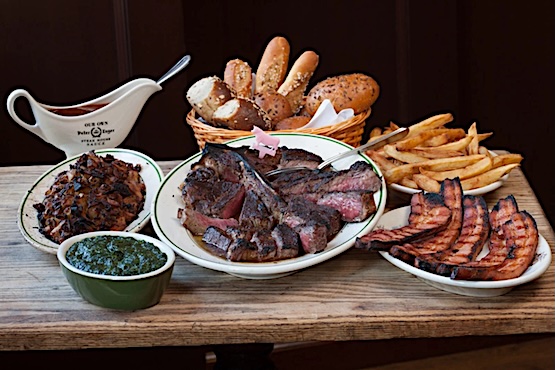 killed
someone not used to it after getting out of
jail?” asked Katie.
The sizzling sliced steaks arrived with
their juices red hot in the plate, along with
some cottage fries and creamed spinach.
“Now, that’s another thing that bothered
me. Heroin
that’s 100% pure is extremely rare, and you
don’t buy it off the street. I never saw any
in my time. Street heroin is almost never pure
because they cut it with sugar, starch, powdered
milk, even rat poison for filler. So, I
went back and checked the records they keep
about what’s out there at any given time, and I
find out that between Christmas and Easter that
year the average heroin was between 32% and 36%
pure. Nothing close to 100% was ever recovered.”
“Where was most of the dope coming from
then?” asked Katie.
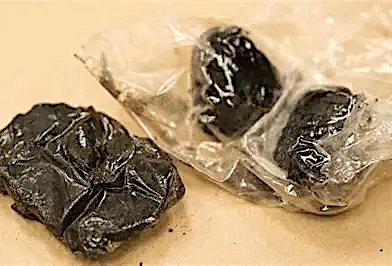 “Back then most heroin was
coming in from Southeast Asia. The so-called
‛black tar’ (left) popular back in the
1970s never got above 30%. And it needed to be
cooked, which was what Vicious did that night.
The average street heroin was no more than 7% to
10% pure. Only when the Colombians got in to the
business in the 1990s did purity become a big
selling point. Could he have died from stuff cut
at less than 40%? Maybe.”
“Okay,”
said Katie, “so what did you think really
happened and did you report your suspicions to
your superiors?”
Houseman took a big bite of
the blood rare beef.
This is a phenomenal steak, isn’t
it? You don’t
find this quality anywhere else but here,
cooked just right, too.”
Katie and David waited for
answer.
“What you should know,” said Houseman,
still chewing, “was that NYPD had been taking a
lot of crap for dereliction of duty in their
investigation of Nancy’s murder. Frankly, I
think it was justified, too. When the FCU—”
“Sorry,” Katie interrupted, “what’s the
FCU?”
“Forensic Crime Unit,” said David.
Houseman went on. “So, when the FCU was
on the scene, somehow they failed to
find the bottle of  Tuinal
tablets Vicious said he’d taken the night before
that knocked him unconscious. Very powerful
barbiturate.Plus, they failed to spot some flaky
brown heroin—which you smoke, you don’t inject
it—and, hard as
it is to believe, three hypodermic needles that
were sitting right on his night table. Two hours
went by before the coroner got there and found
all that stuff and chewed out the guys in the
FCU. Then he took the body and,
no one knows why it took until 8:30 that night
to report that, yeah, Nancy died from a stab
wound. The Chief Medical Examiner had to
corroborate that and said in an interview that
Nancy’s celebrity
status held up the report. Again, why?”
“What do you think?” asked
Katie.
“I don’t know about Nancy, but there was
a lot of talk at the time that Vicious got
railroaded. I wrote out my own report on
Vicious’s death, suggesting alternatives to the
way things were said to have happened. The
report went wherever it went. I never heard
anything about it again. I think that the FCU’s
botching the initial investigation made everyone
look real bad, and things got swept under the
rug, same as with Sid Vicious’s death.”
“So, what did your report say?” asked
David.
“Well, Vicious had talked about a suicide
pact right after Nancy’s death, but obviously he
never followed through. Then he goes to the
slammer for four months, comes out clean and
then goes right back to doing dope. That’s
not unusual for a junkie, but that bullshit
about the dope being 100% pure was bandied
around right from the beginning. The people at
the party were all gone by one or two in the
morning, so that left just Sid’s mother and
himself. Up till he died he hadn’t shown any
depression and everyone said he was in a good
mood. He falls asleep, mama falls asleep, and he
gets up for another fix by day break? It’s all
sounds a little too pat, don’t you think,
David?”
“Yeah, it does. By the way how long does
it take for heroin to show up in a person’s
urine?”
“I’m told about two to six hours. Stays
in the body up to three days.”
“So, there was no question that he had
heroin in him when the coroner looked at the
body?”
“No, that was to be expected. But did he
overdose? On purpose? Accidentally, which is
always what the reports say? Did he inject
himself? Was his mother involved? Someone else?
Anybody want him dead?”
Katie looked at David and said, “Sounds
more than a little like Jimi Hendrix’s death,
doesn’t it? What happened to the body?”
 “Cremated.”
“What happened to his mother? She ever
give up drugs? She still living?”
“She lived a long time after Sid’s death,
even had her own punk band for a while, and was
always on and off drugs. She was definitely on
them when
she wrote some suicide notes, cut her credit
cards in two, then killed herself.”
“When was
that?”
“Nineteen-ninety-six. Fifty-eight years old.
Hey, order the cheesecake. It’s really good.”
“No,
thanks,” said David. “I’m trying to cut down on sweets.”
GLUTTONY
Eating Ourselves Sick
By John
Mariani
 Five thousand three
hundred years ago, a heavily tattooed
46-year-old hunter shepherd with weak knees,
five-foot-three and weighing 110 pounds, with
brown hair and deep-set brown eyes, was trekking
through the high Alps on a late spring day in
search of ibex, chamois and red deer, whose meat
he had eaten for his morning meal, along with
herbed einkorn wheat bread and wild berries he’d
picked along the way.
He wore leather clothes, a cap made from
brown bear fur and a woven grass coat in which he
carried a scraper, drill, and an awl made from
bone, and he carried a copper axe.
The man had been ill recently and, resting
at 10,000 feet, he felt the lack of the stamina
and breath he had in his younger days.
Suddenly an arrow ripped into the man’s
left shoulder. In agonizing pain he tried to yank
out the arrow and grabbed his axe to confront his
attacker but it was too late. A bludgeon came down
on the man’s head and a knife cut a gash through
his hand. Within minutes the man died from a
massive loss of blood.
We
know a great deal about the man in question, for
his murdered body was found in 1991, mummified
under ice, in the Ötzal Alps on the border of
Austria and Italy. The mummy, who has acquired the
name Ötzi and the sobriquet “Iceman,” is now in
the South Tyrol Museum of Archaeology in Bolzano,
Italy, and has been extensively studied by various
scholars using carbon dating and DNA analysis to
reveal that the man suffered from several
maladies, including fatty plaque in his arteries,
whipworm in his gut, even lyme disease. His teeth
and leg bones showed considerable decay,* his hair
had absorbed copper particles and arsenic. This
was not the healthy Homo sapiens we have been
reading about thus far.
* Bone
decay in prehistoric people appears to have
been slight. According to The
Cambridge World History of Food, “Generally,
only about 10 percent of a typical sample of
human archaeological burials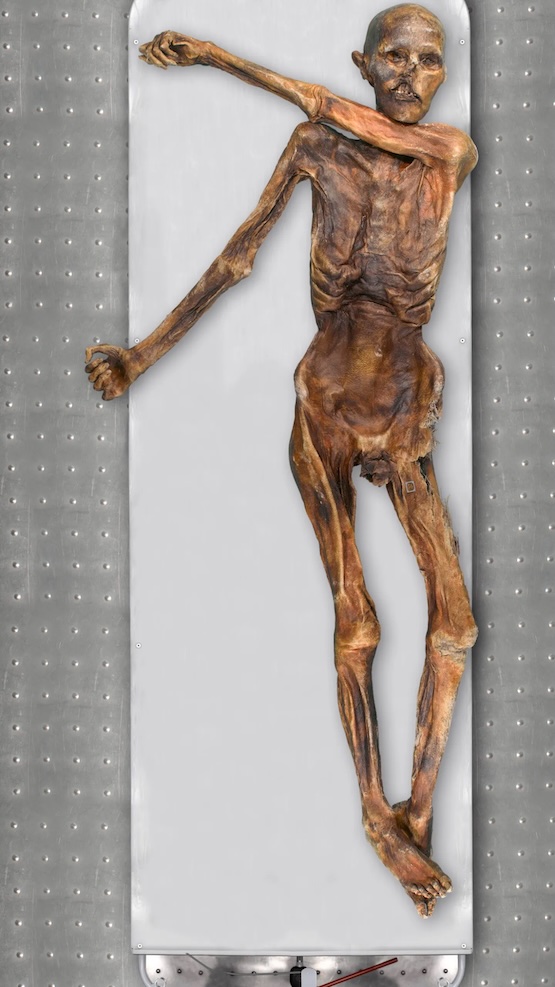 will show any
significant evidence of skeletal disease.”
Ötzi’s weight of 110
pounds was probably average for his
five-foot-three height and frame, and as a hunter
he was likely to eat a modest diet, although it
included highly processed grain and goat’s bacon
he must have acquired from town. He seems also to
have been lactose intolerant, this last a disorder
that his ancestors suffered from but one that in
Europe was decreasing in a period when dairy
farming had become more common and cheese was made
from fresh milk as a way of preserving it.
From all such pathological evidence, Ötzi
emerges as a transitional figure, for he had lived
in the Alps at the dawn of the Copper Age, by
which time Homo sapiens had largely settled down
to a more agrarian style of life. Cattle had been
domesticated 12,000 years BC and dairy farming
began by 7,000 BC.
But Ötzi, who one genetic researcher found
had a higher content of Neanderthal DNA* than most
Homo sapiens of the time, could not drink cow’s
milk for nourishment, which would have helped keep
his bones and teeth strong. His consumption of
processed grain may not have given him the
vitamins and minerals he needed for the hardships
a hunter-gatherer would have to endure climbing
the Alps, where game animals were getting harder
to find and kill than in the past. And the toxins
from his treasured copper axe, which he may well
have smelted himself, were slowly poisoning him.
* Most Neanderthal genes
turned out to be harmful to Cro-Magnon and other
humans, although a 2020 study by Dr. Hugo
Zebert, Janet Kelso and Svante Pääbo of the Max
Planck Institute for Evolutionary Anthropology
and the Karodeepnska Institute discovered that
almost one in three women in Europe have
inherited the progesterone receptor from
Neanderthals, which had a “favourable effect on
fertility. . . [tending] to have fewer bleedings
during early pregnancy, fewer miscarriages, and
give birth to more children.”
Ötzi’s time was passing, and while his
horrible death was at the hands of an enemy, so
advanced was his heart disease that he might not
have lived much longer in any case.
In
several ways, then, Ötzi was a victim of a
changing Neolithic diet at a time when human
beings had so significantly gone from being
hunter-gatherers to farmers.
 In the life of the universe a
million years is but a flick of the fingers, and
200,000 years of human existence would barely even
register as a nano-second. So, once
Homo sapiens had begun to migrate, clear forests,
plant seeds and raise farm animals for both meat
and dairy, a mere 50,000 years of history seems a
very short time for such long-term changes in the
way people were to develop.
Food was starting to taste better. With
each migration human beings discovered new
varieties of plants and wildlife, not least in the
Near East where spices added enticing new flavors
to food that was elsewhere quite bland. As the
Paleolithic Age gave way to the Neolithic 12,000
years ago, a principal inducement for people to
settle in a locale—and largely abandon hunting—was
to have a source for salt, a condiment that would
become essential to the world’s diet. Without a
source, from the sea or an underground mine (some
nearly four miles deep), salt was unobtainable
before trade developed between settlements.
Thousands of years later salt would be fought over
and controlled by the monarchies of Europe, but in
prehistoric times throughout the world it had
become a major enhancement of taste, furthering
the idea that consuming food was no longer only
requisite for sustaining life but at the same time
a true pleasure if a only few grains of salt were
added. Later, about 500 BC, man learned how to
preserve foods in salt that could be eaten
throughout the deprivations of the winter months.
With sufficient amounts of food within a
community, perhaps even a surplus, it is wholly
understandable that cravings other than pre-dinner
hunger pangs would develop. And with more savory
food those cravings become more diffuse. Before
the Neolithic Age, individuals’ cravings seem to
have been kept in check by common consent, lest
one member of the tribe steal another’s portion of
food. But when villages and cities built up
surpluses, a little extra helping here and there
(perhaps taken on the sly) was a form of
self-congratulations for managing the food supply
so well.
The addition to the Neolithic diet that
would later on have enormous repercussions was
alcohol, made from many forms of fermented fruits
and grains. The first alcoholic beverage was mead,
for it is nothing more 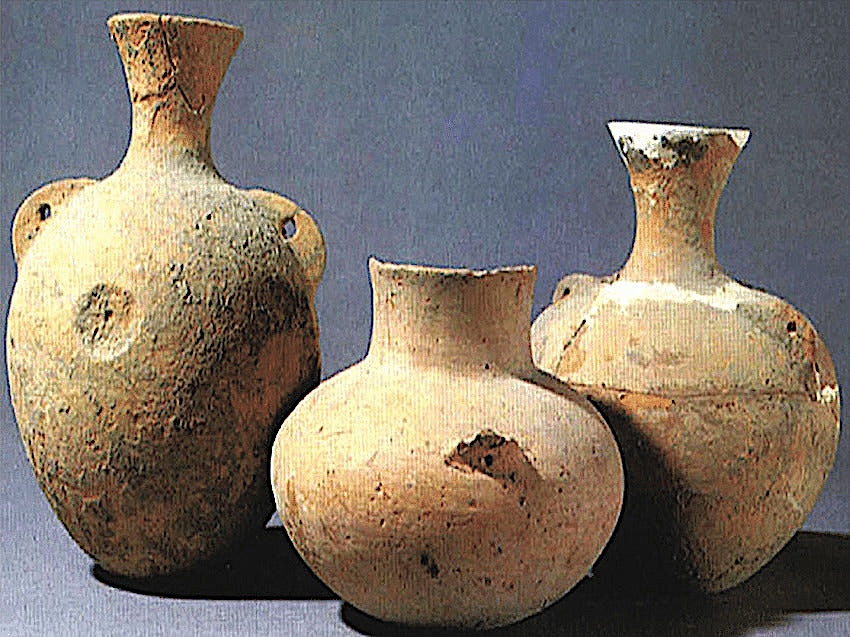 than
honey mixed with water, which begins fermentation
without any human intervention. For
that, it is entirely possible that mead was known
to humans in the Paleolithic Age, with
archaeological evidence from Chinese containers
with traces of mead dating at least to 7,000 BC,
in Europe 2,800 BC and in India 1,700 BC. Flavored
with available nuts and spices, it could be as
delicious as any fruit juice, while packing an
alcohol level of at least 3.5 percent and, if
manipulated, up to 20 percent. It would become the
favorite drink of the Northern European tribes,
and in the 12th century AD the Jewish
rabbi and physician Moses Maimonides believed that
“drinking honey water promotes erections”;
anthropologist Claude Lévi-Strauss called mead a
passage from “nature to culture." We will probably never know
if Homo sapiens used that passage to allow for
unalloyed drunkenness.
 Beer,
made from fermented grains with slightly more
alcohol (4.5 percent) than mead, may date back
13,000 years BC as a kind of fermented gruel, but
the first chemical evidence of barley beer was
found in western Iran, dating between 3,500 and
5,500 BC, which brings it into the last stages of
the Neolithic age; so, too, wine has been traced
to 5,000 years BC in the South Caucasus of
Georgia, and therefore plays no part in this
chapter’s discussion. (Distilled spirits were not
created until the 8th century AD., by Sufi
Arabs.)
By the time Mesopotamia emerged about 3,500
years BC as a true civilization, it had already
been 3,500 years after man had begun to cultivate
the earth. Within that span, as humans learned to
find, grow and enjoy an increasing number of
grains and cereals, spices and herbs, like
horseradish and, later, chile peppers, with
stimulating properties—cooked over fire and
sprinkled with salt—the allure of foods was
stronger than ever before, which led to cravings
that in the past could never have been satisfied.
Of all man’s desires
and needs, eating enough is paramount, with sex
running a close second. As we shall see, the two
would become an indelible part of human society,
but while we can easily imagine Homo sapiens
indulging in celebratory feasts, ritual sacrifices
and sexual orgies, it would not be easy to make a
case that it included gluttonous eating and
drinking until close family settlements grew into
much large entities.  The
more adolescents, brothers, sisters, cousins,
aunts, uncles and warriors the more opportunities
presented themselves for larger feasts and parties
with all the usual temptations.
Every one of what Christianity would call the
Seven Deadly Sins was certainly a part of the
prehistoric psyche—fornication, greed, pride,
despair, wrath and vainglory—except gluttony,
which is a form of self-abuse whose indulgence is
largely dependent on an abundance of food and
alcohol likely to cause harm, first to the
individual and then to his immediate society.
As Philosophy
professor A.C. Grayling has written, “Our genes,
our biological imperatives, the evolutionary
history of which we are part, are far more
imperious than our wills."
In other
words, in the clutches of a craving, our wills are
no longer free.
Chapters of Gluttony will
appear biweekly.
❖❖❖
NOTES FROM THE WINE CELLAR
DO WINES NEED TO "BREATHE"?
By John Mariani

The answer to the question above is a
qualified no.
To get that
qualification out of the way, the only wines that may
benefit from “breathing,” in order to allow oxygen
to react with the bottled-up wine, are newly
released big reds like Cabernet Sauvignon, Syrah,
Nebbiolo and Malbec. Even then, simply popping the
cork and letting the wine sit on the table exposes
so little of the wine to the air that it is of no
use. Decanting such a wine will allow it to interact
throughout with the air, but 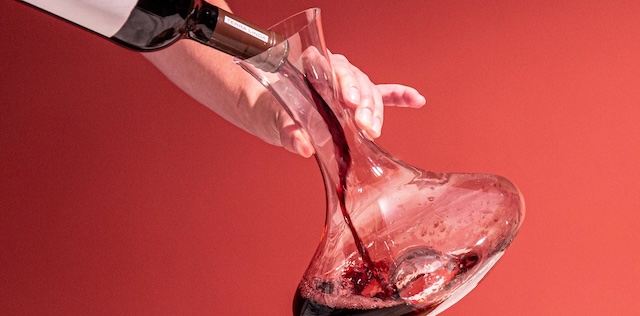 so
will simply pouring into your glass and swirling it
before tasting. (Swirling it around in your mouth at
the table is mere gross pretension.) The rest of the
wine in the bottle will have absorbed oxygen as it
burbles out of the bottle. Decanting should be done
carefully, and only to drain way the tannin
sediments that bottle may have acquired.
I once knew an eccentric wine
critic for Vogue who, anticipating he would
be drinking a certain red wine that evening, would
get up at hourly intervals as of five AM until the
wine tasted what he thought was at its peak flavor.
Of course, the wine then sat around until 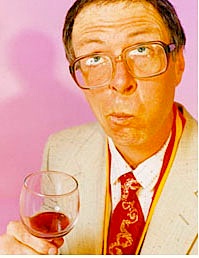 dinner time, changing every
minute until then.
Medium-bodied reads like Pinot
Noir and Grenache gain little by such exercises, and
with old reds––more than 20 years–you have to be
very careful that a fragile wine will become overly
oxygenated quickly and start to fade or taste
vinegary. I once tasted a 1929 Lafite-Rothschild
that had been decanted and I was amazed it was still
drinkable, but after fifteen minutes it had become
vinegary and un-drinkable.
With white wines there are none that require
breathing for more than the time it takes to swirl
it in your glass, simply to release the bouquet.
Chardonnay, Chenin Blanc and Pinot Gris gain nothing
from aerating. Sherries, which by their fortified nature
already have a somewhat oxydated flavor, need
nothing more to make them better once out of
the bottle.
Given these precautions, how should one treat
a wine whose bottle has not been finished during a
meal? Will it turn bad by the following day? Again,
I wouldn’t want to keep older Bordeaux or Barolos
for more than a couple of days on the counter.
Younger wines will be fine for two or three, maybe
four.
In fact, in many cases I’ve found
that the wine’s elements of tannin, fruit and acid
have balanced out and that some oxygen may have
helped that happen.
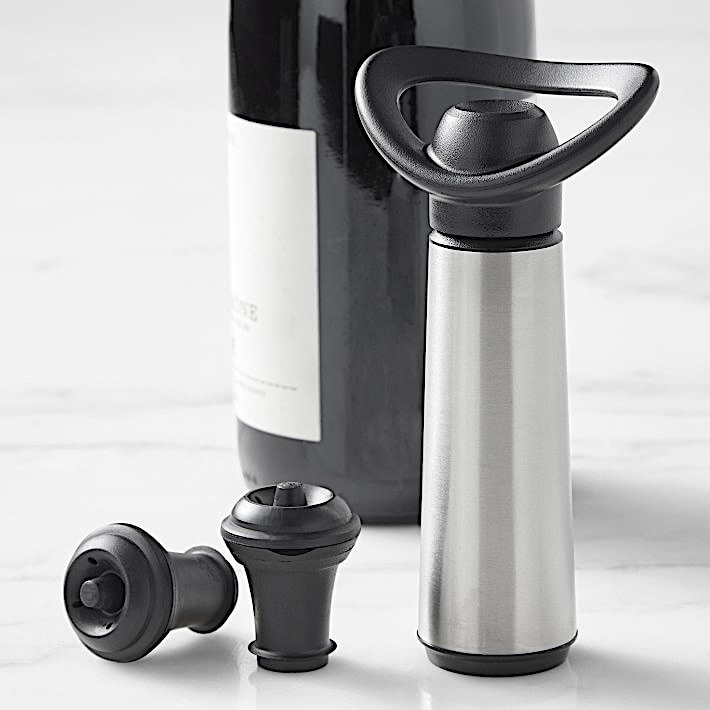 To
keep my opened bottles in good shape, I use a rubber
stopper and a plastic pump that sucks out the oxygen
layered above the remaining wine, protecting it from
further oxidation––though just sticking the original
cork back in is usually just fine. I can’t really
say one way or the other if sticking the bottle in
the ‘fridge does anything to preserve it.
So, in the
case of those wines you drink on a daily basis and
assuming you are pulling up your oldest Premier Crus
for your connoisseur guests, there’s little reason
to fret whether your wine will taste any better
after fifteen minutes on the counter than it will
after a few good swirls in your glass.
 YET
ANOTHER GOOD REASON
TO JOIN THE BUNDESWEHR
Germany’s armed forces, the
Bundeswehr, are running a pilot study to determine
if a CA-1 robotic mess kitchen can keep up with
cooking and feeding of 900 marines and
homeland defense troops at the Hugo Junkers
barracks. In the space of an
hour it can churn out more than 200 dishes from a
menu including fusilli bolognese, penne with garlic
prawns, chilli con carne and Kaiserschmarrn
pancakes. Once the food is ready, a
second appendage puts on the finishing touches and
then serves up the meal, all within a matter of
minutes.
❖❖❖
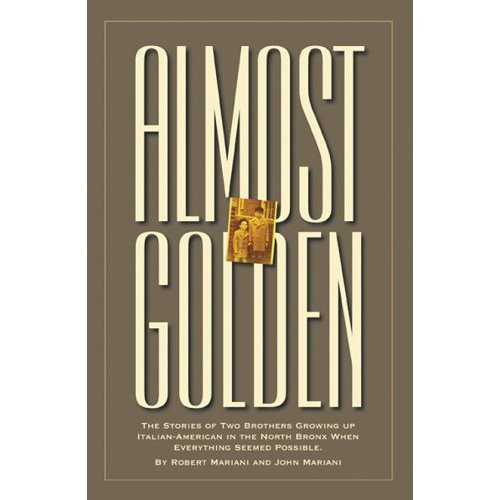
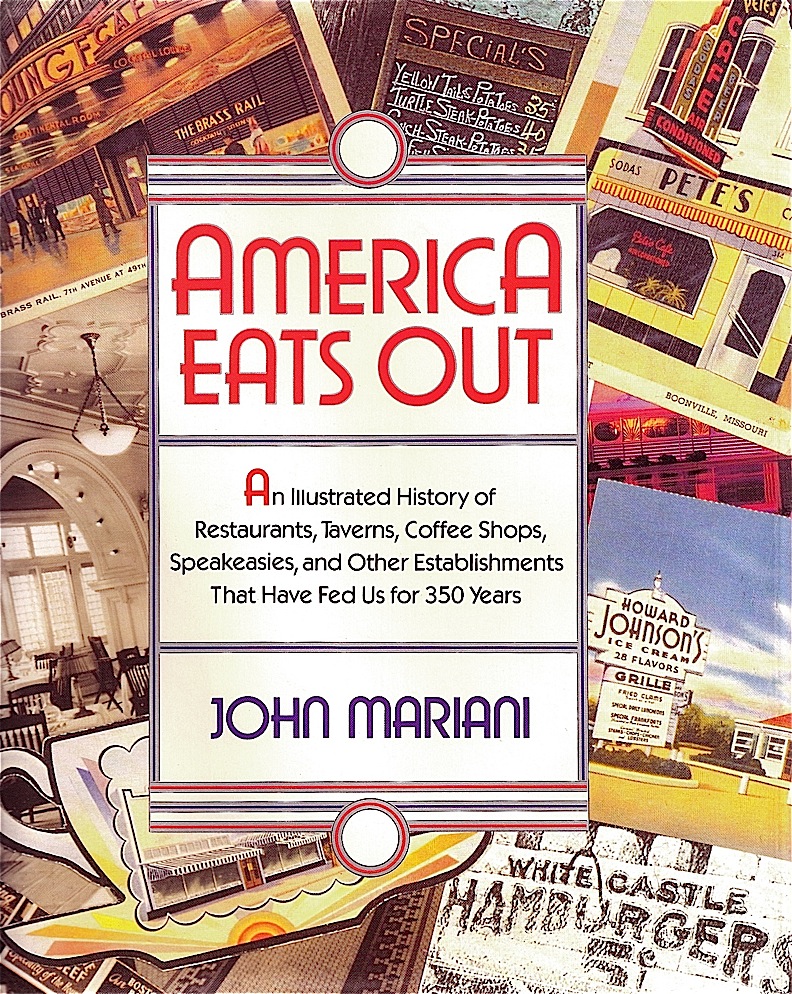
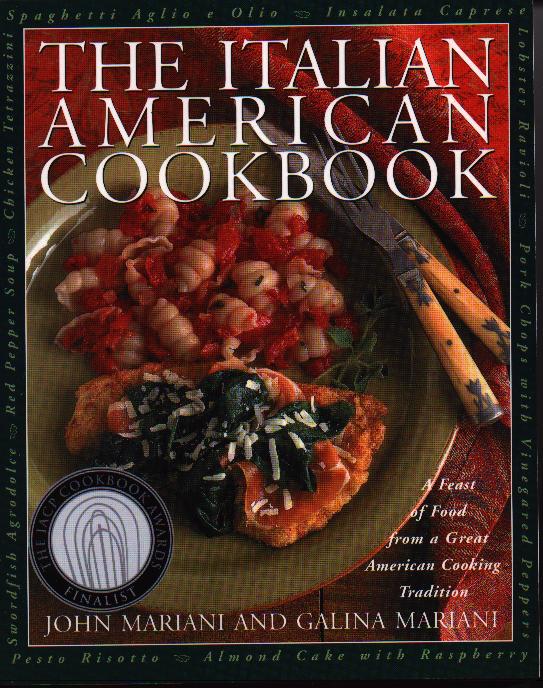
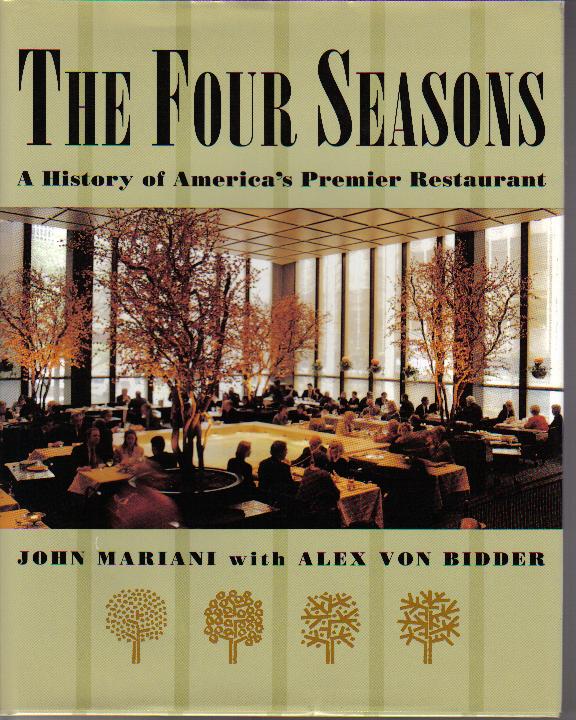
Any of John Mariani's books below may be ordered from amazon.com.
 The Hound in Heaven
(21st Century Lion Books) is a novella, and
for anyone who loves dogs, Christmas, romance,
inspiration, even the supernatural, I hope you'll find
this to be a treasured favorite. The story
concerns how, after a New England teacher, his wife and
their two daughters adopt a stray puppy found in their
barn in northern Maine, their lives seem full of promise.
But when tragedy strikes, their wonderful dog Lazarus and
the spirit of Christmas are the only things that may bring
his master back from the edge of despair.
WATCH THE VIDEO!
“What a huge surprise turn this story took! I was completely stunned! I truly enjoyed this book and its message.” – Actress Ali MacGraw
“He had me at Page One. The amount of heart, human insight, soul searching, and deft literary strength that John Mariani pours into this airtight novella is vertigo-inducing. Perhaps ‘wow’ would be the best comment.” – James Dalessandro, author of Bohemian Heart and 1906.
“John Mariani’s Hound in Heaven starts with a well-painted portrayal of an American family, along with the requisite dog. A surprise event flips the action of the novel and captures us for a voyage leading to a hopeful and heart-warming message. A page turning, one sitting read, it’s the perfect antidote for the winter and promotion of holiday celebration.” – Ann Pearlman, author of The Christmas Cookie Club and A Gift for my Sister.
“John Mariani’s concise, achingly beautiful novella pulls a literary rabbit out of a hat – a mash-up of the cosmic and the intimate, the tragic and the heart-warming – a Christmas tale for all ages, and all faiths. Read it to your children, read it to yourself… but read it. Early and often. Highly recommended.” – Jay Bonansinga, New York Times bestselling author of Pinkerton’s War, The Sinking of The Eastland, and The Walking Dead: The Road To Woodbury.
“Amazing things happen when you open your heart to an animal. The Hound in Heaven delivers a powerful story of healing that is forged in the spiritual relationship between a man and his best friend. The book brings a message of hope that can enrich our images of family, love, and loss.” – Dr. Barbara Royal, author of The Royal Treatment.
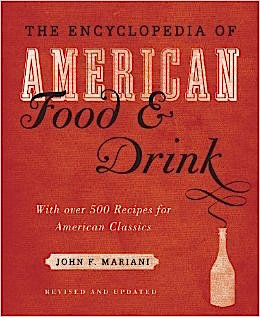 |
The Encyclopedia of American Food and Drink by John F. Mariani (Bloomsbury USA, $35) Modesty forbids me to praise my own new book, but let me proudly say that it is an extensive revision of the 4th edition that appeared more than a decade ago, before locavores, molecular cuisine, modernist cuisine, the Food Network and so much more, now included. Word origins have been completely updated, as have per capita consumption and production stats. Most important, for the first time since publication in the 1980s, the book includes more than 100 biographies of Americans who have changed the way we cook, eat and drink -- from Fannie Farmer and Julia Child to Robert Mondavi and Thomas Keller. "This book is amazing! It has entries for everything from `abalone' to `zwieback,' plus more than 500 recipes for classic American dishes and drinks."--Devra First, The Boston Globe. "Much needed in any kitchen library."--Bon Appetit. |
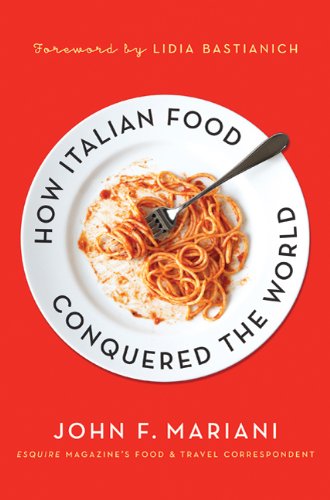
"Eating Italian will never be the same after reading John Mariani's entertaining and savory gastronomical history of the cuisine of Italy and how it won over appetites worldwide. . . . This book is such a tasteful narrative that it will literally make you hungry for Italian food and arouse your appetite for gastronomical history."--Don Oldenburg, USA Today. "Italian
restaurants--some good, some glitzy--far
outnumber their French rivals. Many of
these establishments are zestfully described
in How Italian Food Conquered the World, an
entertaining and fact-filled chronicle by
food-and-wine correspondent John F.
Mariani."--Aram Bakshian Jr., Wall Street
Journal.
"Equal parts
history, sociology, gastronomy, and just
plain fun, How Italian Food Conquered the
World tells the captivating and delicious
story of the (let's face it) everybody's
favorite cuisine with clarity, verve and
more than one surprise."--Colman Andrews,
editorial director of The Daily
Meal.com. "A fantastic and fascinating
read, covering everything from the influence
of Venice's spice trade to the impact of
Italian immigrants in America and the
evolution of alta cucina. This book will
serve as a terrific resource to anyone
interested in the real story of Italian
food."--Mary Ann Esposito, host of PBS-TV's
Ciao
Italia. "John Mariani has written the
definitive history of how Italians won their
way into our hearts, minds, and
stomachs. It's a story of pleasure over
pomp and taste over technique."--Danny Meyer,
owner of NYC restaurants Union Square
Cafe, The Modern, and Maialino.
|
 |
 |
 |
 |
 |
 |
MARIANI'S VIRTUAL GOURMET
NEWSLETTER is published weekly. Publisher: John Mariani. Editor: Walter Bagley. Contributing Writers: Christopher
Mariani, Misha Mariani, John A. Curtas, Gerry Dawes, Geoff Kalish.
Contributing
Photographer: Galina Dargery. Technical
Advisor: Gerry
McLoughlin.
If you wish to subscribe to this
newsletter, please click here: http://www.johnmariani.com/subscribe/index.html
© copyright John Mariani 2026