MARIANI’S
Virtual Gourmet
April
5, 2026
NEWSLETTER
ARCHIVE
❖❖❖
THIS WEEK
RENÉ REDZEPI RESIGNS FROM NOMA:
WHAT HAPPENS NEXT?
By John Mariani
NEW YORK CORNER
LE GRATIN
By John Mariani
THE BISON
CHAPTER SIXTEEN
By John Mariani
NOTES FROM THE WINE CELLAR
THE WHITE WINES OF PORTUGAL
By John Mariani
RENÉ REDZEPI RESIGNS FROM NOMA:
WHAT HAPPENS NEXT?
By John Mariani
 The
resignation of Danish chef René Redzepi from
his much hyped and honored NOMA restaurant in
Copenhagen over charges he does not deny of
bullying his staff for years has sent shock
waves through the industry. His behavior was
one of those dirty little secrets that staff
dare not speak about for fear of firing, and,
as with the Epstein files, people who knew the
truth are saying they had no idea what was
going on.
The
resignation of Danish chef René Redzepi from
his much hyped and honored NOMA restaurant in
Copenhagen over charges he does not deny of
bullying his staff for years has sent shock
waves through the industry. His behavior was
one of those dirty little secrets that staff
dare not speak about for fear of firing, and,
as with the Epstein files, people who knew the
truth are saying they had no idea what was
going on.
Redzepi’s behavior
went beyond unleashing a fierce temper––hardly
rare among chefs––to acts of punching and
slamming and sticking forks into worker’s
bodies, according to a report by Julia Moskin
in the New York Times this week, based
on interviews with dozens of former employees.
“Going to work felt like
going to war,” Alessia, a former cook at NOMA
told Moskin.
“You had to force yourself to be
strong, to 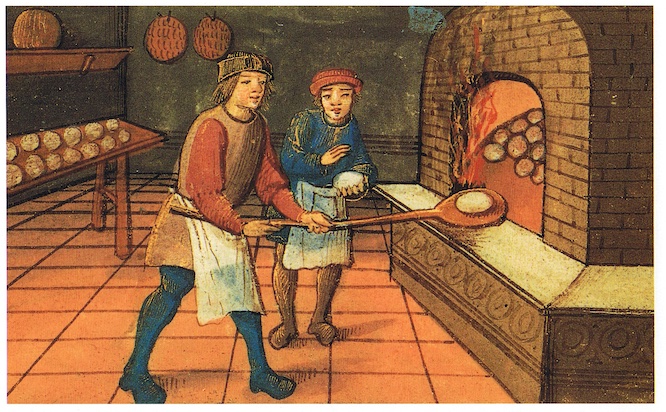 show no
fear.”
show no
fear.”
The repercussions were
immediate: In Los Angeles where Redzepi was
doing a sold-out pop-up series of dinners for
$1,500 per person, sponsors began to pull out
and protesters arrived outside the door. But
the story has opened the rotted door to a
perennial problem that was once an entrenched
tradition of chefs abusing their staff, going
back to the Middle Ages when cook’s guilds had
access to unpaid interns called stagiares
who worked for room and board in hopes of
joining the guild. That practice has gone on
into the last century when young cooks eager
to work in a prestigious kitchen did so for
next to no pay.
 Back
in 1933 George Orwell (left; author of
1984) wrote of his agonizing stint as a
plongeur––dish washer–– at a restaurant
in Paris where abuse was part of the routine.
The chef would rant at his cooks, in order of
their place on the line, the cooks would
berate the service staff and the staff would
rage at the scullery maid and the dishwashers,
with everyone cursing at the top
Back
in 1933 George Orwell (left; author of
1984) wrote of his agonizing stint as a
plongeur––dish washer–– at a restaurant
in Paris where abuse was part of the routine.
The chef would rant at his cooks, in order of
their place on the line, the cooks would
berate the service staff and the staff would
rage at the scullery maid and the dishwashers,
with everyone cursing at the top 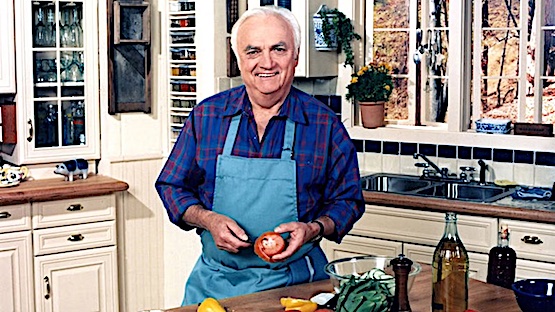 of
their lungs.
of
their lungs.
Pierre Franey (right),
the esteemed French chef who became a Times
food columnist, once told me how at a very
high-up restaurant in France, the chef would
abuse everyone constantly. One night he
slapped Pierre across the face with a spatula.
“It stung like hell and brought tears to my
eyes,” he recalled. “I threw down my hat and
apron and went upstairs to my locker and
planned to walk out the door. But the chef
came running up after me and shouted, ‘Why are
you leaving, Pierre? You’re one of the only
people I like here!’ I went back downstairs
and went to work. That was the way it was.”
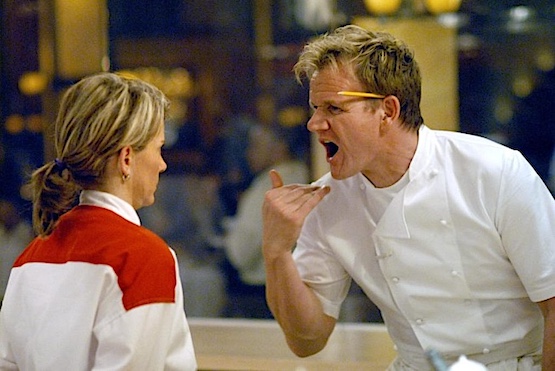 Chefs
of every stripe from just a generation ago
remember such treatment, silently suffering to
keep their jobs. Star chef Gordon Ramsay, who
has made a TV career out of screaming at cooks
on “Hell’s Kitchen,” told of how his master,
the tyrannical Marco Pierre White (below),
in London
Chefs
of every stripe from just a generation ago
remember such treatment, silently suffering to
keep their jobs. Star chef Gordon Ramsay, who
has made a TV career out of screaming at cooks
on “Hell’s Kitchen,” told of how his master,
the tyrannical Marco Pierre White (below),
in London 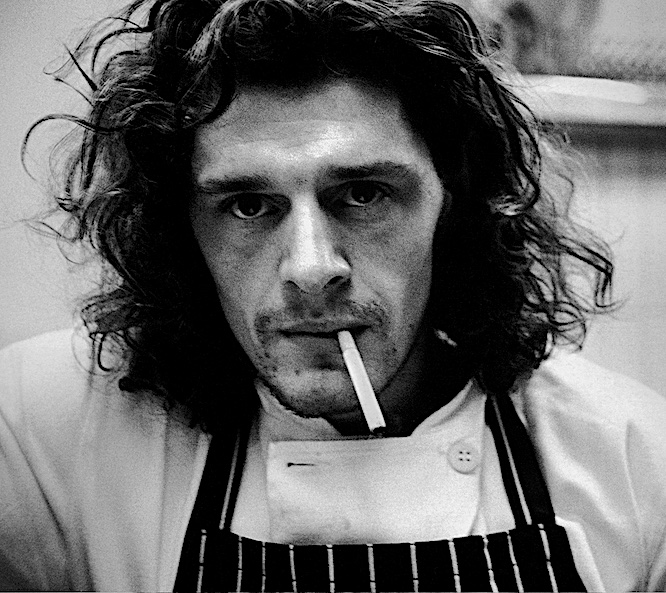 literally had him
cowering in a corner of the restaurant more
than once. A manager named Carl Bruggemeir,
who worked for restaurateur Warner LeRoy,
owner of Tavern on the Green, told me he threw
a steak he thought was not thick enough
straight at his chest. “I just picked it up,”
he said, “changed my shirt and went back on
the floor.”
literally had him
cowering in a corner of the restaurant more
than once. A manager named Carl Bruggemeir,
who worked for restaurateur Warner LeRoy,
owner of Tavern on the Green, told me he threw
a steak he thought was not thick enough
straight at his chest. “I just picked it up,”
he said, “changed my shirt and went back on
the floor.”
The once famous, now
infamous. Mario Batali and his reptilian
partner Joe Bastianich were notorious for
drunken behavior that eventually revealed
Batali’s sexual harassment. And as Anthony
Bourdain described the atmosphere at the New
York restaurant Les Halles, the common
language of the kitchen was largely
billingsgate.
 Because of
the Batali accusations in 2017, shivers went
up the spines of chefs well known for their
brutal management style, not least because
Human Resources and restaurant workers unions
laid
down the rules about abuse, lest a staff
member sue the chef or restaurateur. Open
kitchens where guests can see and hear what’s
going on behind the cook stations are also
buffers for bad behavior.
Because of
the Batali accusations in 2017, shivers went
up the spines of chefs well known for their
brutal management style, not least because
Human Resources and restaurant workers unions
laid
down the rules about abuse, lest a staff
member sue the chef or restaurateur. Open
kitchens where guests can see and hear what’s
going on behind the cook stations are also
buffers for bad behavior.
Good managers are now
expected to take staff complaints seriously
and to remind belligerent chefs to keep a lid
on their anger, like a pot boiling over.
It’s highly unlikely
all such bad behavior has disappeared from the
back of the house, just as it’s naïve to think
that the behavior of the sleazy stocks and
bonds characters in the movie “The Wolf of
Wall Street” was exaggerated––according to my
friends in the industry it was not.
The TV show “The Bear” shows that the loyal
opposition, the staff, can be every bit as
rough and tumble on a new young chef. 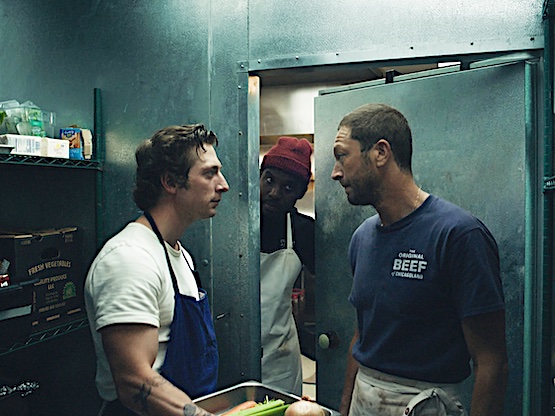
Restaurant kitchens are
often said to be pressure cookers, both
literally and figuratively, where mistakes can
mean cuts and burns and inefficiency can cost
profits. It’s an environment where knives are
flashing, flames are flaring and pans of hot
liquids get spilled. Tantrums will occur, the
lingo can be as rough as on stevedores’ docks.
You won’t hear about
all that from the harried restaurateur or
manager up front, who must put on a face of
calm cordiality. Behind the kitchen door you
do not hear the shouting, the cursing, the
glasses smashed against the wall or the
pots banged down out of frustration.
Yet clearly Redzepi’s
behavior went beyond the usual abuse found in
kitchens. He and others like him would claim
that it is their monomaniacal insistence on an
unachievable perfection that causes them to be
the way they are. But like all people who live
within a tornado of rage, they need to get
some help, some counseling and be
brought down to earth before they do any more
damage.
I
do think this incident with Redzepi will have
a widespread effect in the industry because,
from investors to customers, no one wants to
be associated with the worst aspects of a bad
kitchen. At its most basic, nobody wants to
fear an outraged chef spitting in the soup.
NEW YORK CORNER
LE
GRATIN
5 Beekman
Street
212-597-9020
By John Mariani
Not
everyone has fond memories of their mother’s
cooking, but I suspect every Frenchman does, and
I’ve seen master cuisiniers brought to tears
remembering their maman’s roast chicken
or tarte Tatin. In the case of Daniel Boulud,
who came to the U.S.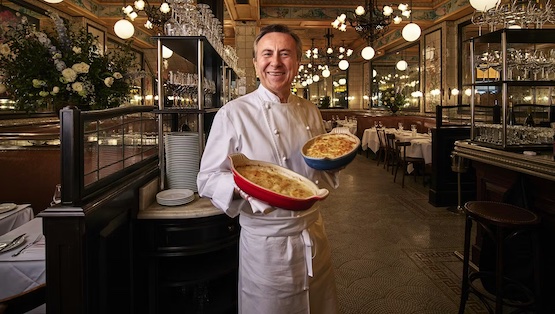 in 1982 and whose empire now ranges from the
flagship Daniel in New York, among others, to
Maison Boulud in Singapore and Brasserie Boulud
in Dubai, it is his mother’s potato gratin back
at his family’s farm in Lyon that guides his
cooking to this day.
in 1982 and whose empire now ranges from the
flagship Daniel in New York, among others, to
Maison Boulud in Singapore and Brasserie Boulud
in Dubai, it is his mother’s potato gratin back
at his family’s farm in Lyon that guides his
cooking to this day.
Along with Café Boulud, Le Pavillon and La
Tête d’Or in Manhattan––all serving different
iterations of French food–his four-year-old Le
Gratin is perhaps closest to his heart, for it is
a bouchon, the Lyonnais word for a bistro
serving the local fare. (Boulud might have used
that word, but it’s already taken by Chef Thomas
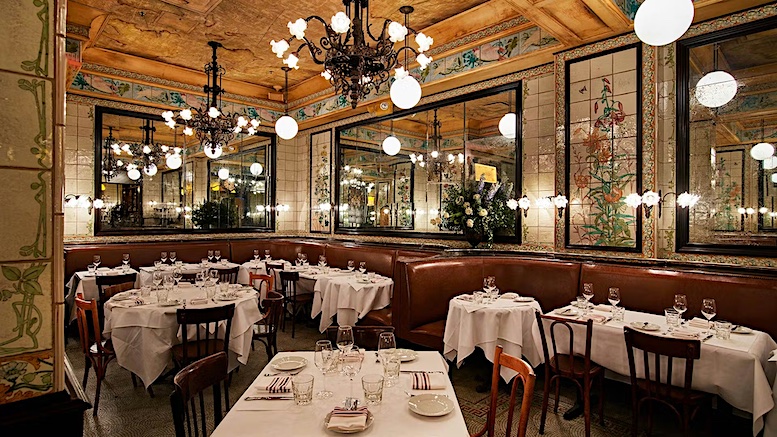
Keller for his Bouchon Bakery uptown). Le Gratin
certainly has the art nouveau flair of a Paris
bistro, even to the way it looks decades old in
the color and patina of its flowery art nouveau
tiles, globe lights, mirrors, sturdy bentwood
chairs, well-draped tables and commodious dark red
banquettes. 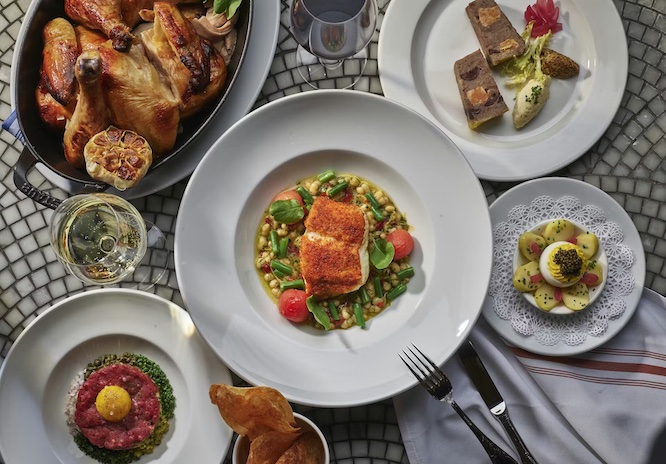 As
would be the case in Paris or Lyon, the service
station is near the middle to allow a server
quickly to pick up silver, china and napery. The
service itself is fleet on its feet, which lends
to the gaiety of being in this space, and the
noise level allows for conversation, though not
helped by a wholly out of place intrusion of
thumping music Boulud would never have in
France.
As
would be the case in Paris or Lyon, the service
station is near the middle to allow a server
quickly to pick up silver, china and napery. The
service itself is fleet on its feet, which lends
to the gaiety of being in this space, and the
noise level allows for conversation, though not
helped by a wholly out of place intrusion of
thumping music Boulud would never have in
France.
The menu is true
to form, with specials each night, and after one
visit you will have your favorite dishes, as you
might at Benoit, Frenchette and La Goulue.
The wine list is solidly stocked with
French bottles in every price category and you
should consult the gracious sommelier Clara
Charpentier as to what your taste and budget are.
 Excellent,
crisp-crusted
bread (complimentary, merci) though one
pat of butter for four people was skimpy.
Excellent,
crisp-crusted
bread (complimentary, merci) though one
pat of butter for four people was skimpy.
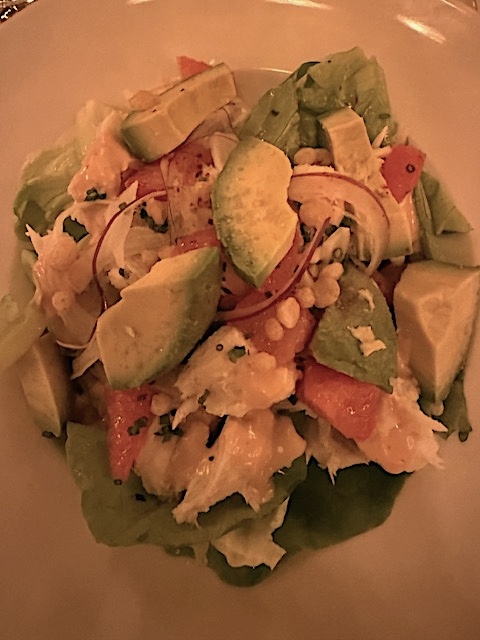
There are oysters, of course, but I was
giddy over crab Marie-Rose––a classic British
recipe––(left) whose jumbo lump crabmeat
was not only truly jumbo size but
abundant in a salad of Boston lettuce, pink
grapefruit, avocado and cocktail sauce. With the
retail price of jumbo crab going for $60, this
dish at $29 is a dizzying bargain. So,
too, a poached leek salad had plenty of flavor
from the softened 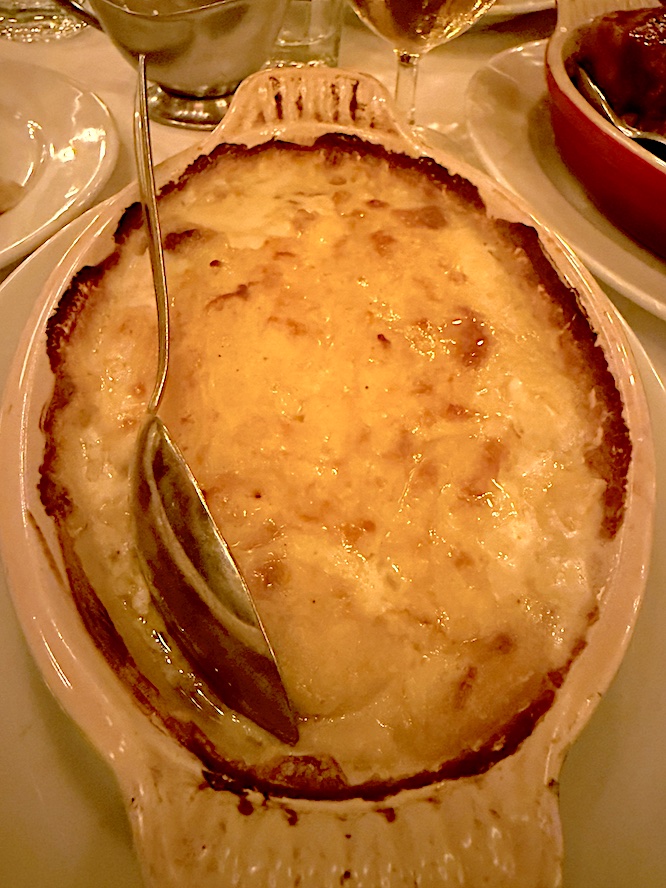 eeks
themselves, subtly enhanced with a mustard
vinaigrette and rich sauce mousseline.
eeks
themselves, subtly enhanced with a mustard
vinaigrette and rich sauce mousseline.
Onion soup gratinée (right) had
an extraordinarily deep and intense broth teaming
with caramelized, onions, sweet as candy and
croutons and topped with a fine layer of Gruyère
cheese, though it should have been better browned
one evening.
Speaking
of abundance, the chicken done on a rotisserie was
a half of a very plump Label Rouge chicken (a
premium fowl certified in France since 1965 for
its superior quality and taste) bathed in a lovely
garlic juice and accompanied by––here it was!––Boulud’s mother’s
potato gratin, which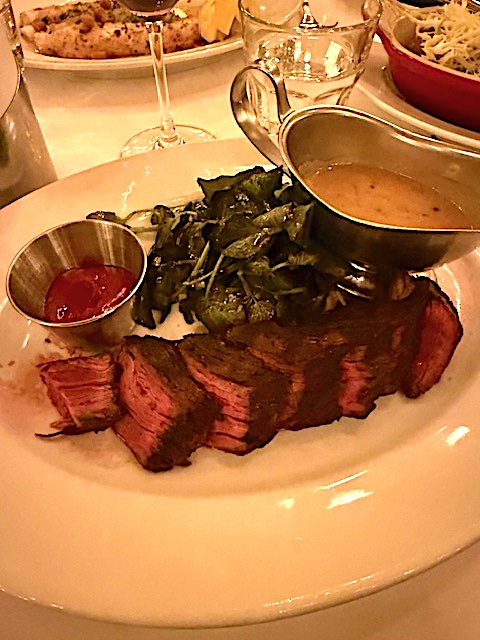 was indeed a glorious dish, whipped full of butter
and cream to please any child of adult for sheer
gustatory pleasure.
was indeed a glorious dish, whipped full of butter
and cream to please any child of adult for sheer
gustatory pleasure.
Steak frites could not be improved
upon, with eight ounces of prime black Angus
hanger steak possessing the requisite minerality
and chew, served with a red wine shallot sauce.
Curiously, a cone of frites was limp and
tepid, but on request were replaced within moments
by a fresh crisp batch. 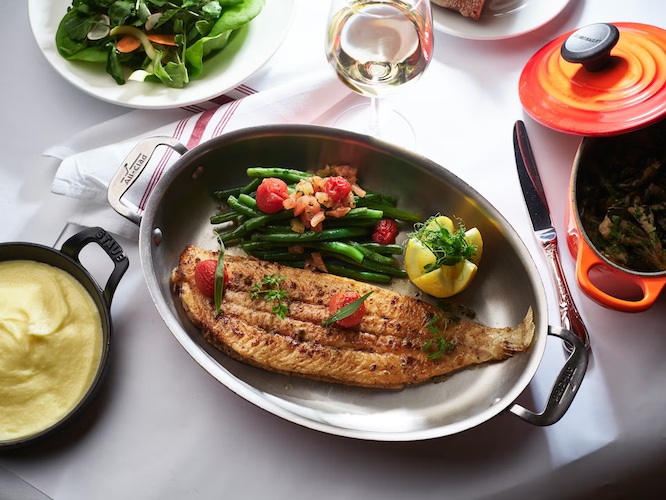
I love calf’s liver but
rarely see it on a menu anymore, so I was very
happy to find it at Le Gratin, cooked perfectly
pink and mounted
on butter-rich mashed potatoes with caramelized
cipollini onions, broccoli, and a charcuterie
sauce. Perhaps best of all in this stellar lineup
was Dover sole à la grenobloise, a very
fat fish swimming in a lemon kissed and caper
strewn brown butter.
 Desserts
are all you expect at a bistro and
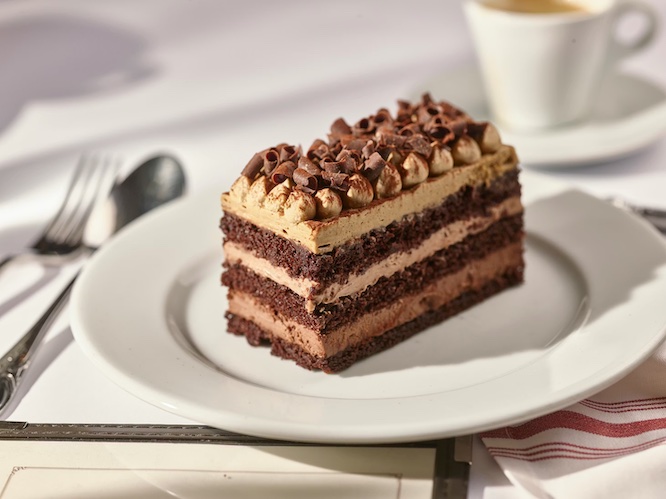
generous––plump, layered profiteroles; very dark
chocolate mousse, a crisp apple tart and a layered
chocolate cake.
Desserts
are all you expect at a bistro and
generous––plump, layered profiteroles; very dark
chocolate mousse, a crisp apple tart and a layered
chocolate cake.
New York is richer than
ever in French bistros, all more or less with the
same menu and similar decors, but none I know of
has the lusty spirit of Le Gratin, where the food
seems to be cooked with the idea of complete
satisfaction behind it all within an atmosphere
that never gets tired, even in a jaded city like
New York.
Open Tues.-Sun. 11:30 AM
to 10 PM.
❖❖❖
THE BISON
By John Mariani

CHAPTER
SIXTEEN
Katie thought it was
time to call Alan Dobell.
“Listen, Alan, this Epstein story has
tentacles that reach into the British royal
family. One of the men Epstein fixed up with
underage girls was Prince Andrew, Elizabeth’s
son. He apparently and brazenly traveled all
over the western hemisphere with her.”
“How old was she?” Dobell asked.
“Sixteen, seventeen.”
“And this information comes from what
source?”
Katie knew that a prostitute, even one
on the inside of Epstein’s mansion, wasn’t
going to be enough for her editor.
“And you
believe this prostitute? Any other evidence?
Photos?”
“Apparently it was part of Epstein’s
modus operandi to make sure he got photos of
everyone at his parties hanging out with the
girls. That way he could always keep them
silent.”
“And where are those?”
“I don’t know, Alan, I’m just finding
these things out now. I do know that when I
visited Epstein in his office here in New York
the room was lined with photos of important
men.”
“Any of them with these girls?”
“I didn’t get close enough to see.”
Katie heard Dobell sigh deeply.
“Listen, Katie, I suspect you’ve got a
real story here, a sleazy one but a story
nonetheless. Even so, I’m still not sure this
is for McClure’s unless there’s a
financial angle, men in power trading
influence for sex, that kind of thing. But
I’ll do this: Take another week or so and see
if you can nail anything down that someone
could take into court. I mean it's not like
everybody doesn’t already know that Epstein’s
some kind of libertine. But it’s only if he’s
trafficking underage girls that it becomes a
real crime. You’ve got to get one of the men,
or maybe several, to tell you what was going
on in his homes, and whether any of them knew
those girls were underage.”
Katie said thanks and that if she
didn’t have anything on firmer grounds in a
week, she’d drop the story.
“You coming back to New York soon?”
asked Dobell.
“That depends if I’ve exhausted the
possibilities down here. I’ll let you know if
I am.”
Dobell hung up, leaned back in his chair,
swiveled around once and said to himself, “I
really hope she finds something.”
Katie told David
everything she’d learned from Susannah. “Well,”
he said, “she’s right about nobody in a court
room taking her seriously, and she would
get ripped apart by the defense.”
“I wonder if we can find this girl
Virginia Roberts, if that’s her name. Guess we
can ask Ramona.”
“Guess we can. And if she is a local
girl there’s got to be some records of her in
town. I’ll ask Terry to check.”
“Good idea,” said Katie. “Okay, you
call Terry and I’ll contact Ramona. See you at
dinner, eight o’clock in the lobby?”
“Make it seven o’clock in the bar.”
Katie wondered if Sanchez would take
her call on a Sunday afternoon after her
caipirhiñas and TV shows, but she dialed her
number.
“Quién es?” came Sanchez’s voice
on the line.
“Ramona, it’s me, Katie Cavuto,” and
without waiting for Sanchez to reply said, “I
had a good talk with Susannah, and she gave me
a lot to go on. You mind if I ask you about
one thing she told me?”
Sanchez said
nothing, so Katie asked, “Do you know of a
girl named Virginia Roberts who was supposed
to be hooked up with Prince Andrew of the
British Royal Family?”
Sanchez laughed. “Everybody knew about
Andrew, and everybody knew he was screwing
with Virginia. Some of the men were amazed
how—what do you say?—blatant he was.
But no one said anything. She was another of
Ghislaine’s girls, same routine as with
Susannah. But Virginia was already a girl in
trouble. She had a bad family, ran away, lived
on the streets, but she looked so good it
didn’t matter, and I doubt Andrew even cared
about her background.”
“Do you know if she’s still here in
Palm Beach?”
“Last I heard she flew off to Thailand
to train at some massage therapy school Jeremy
wanted her to go to. Jeremy was very big on
massages, and that’s how Ghislaine got these
girls to let down their guard. Ghislaine is
just another pervert but with a British
accent.”
It all sounded exactly as Susannah had
told it about herself.
“And that’s the last you heard of her?”
“That’s the last I heard. I don’t think
she came back here. If she did I would have
heard she was back with Jeremy or at some
brothel.”
Katie thanked Sanchez and asked if she
could call again.
If Roberts were still in Thailand it
was going to be difficult to trace her unless
she could somehow get information out of the
Transportation Security Administration. Maybe
David could find out. Meanwhile David had
phoned Terry Rush, who said he couldn’t find
out anything on a Sunday, so David thought,
“Fine, I’ll just have a relaxing evening with
Katie.”
They met at the bar of the hotel, whose
restaurant was nothing special, so they went
to Joe’s Stone Crab on Miami Beach, a
tourist-driven restaurant that dated back to
1913 and was made a historic landmark as of
1975. Once
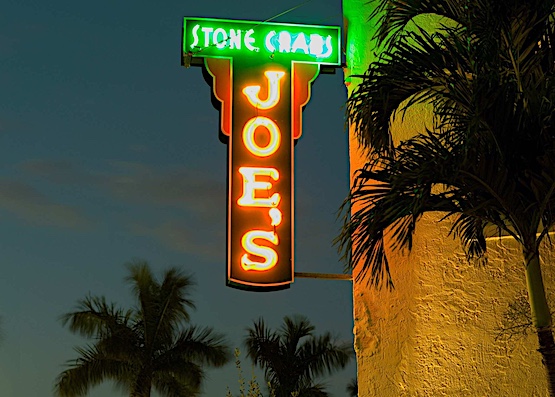
called Joe’s Diner, it was now a big two-story
place made to look like a southern mansion,
one with a red-and-green neon sign reading
“JOE’S.” David didn’t bother to call ahead,
even though he knew the restaurant didn’t take
reservations, which could make the high season
wait at the maître d’s stand interminable
unless that same maître d’ was slipped a
sizeable tip up front to move a party up the
wait list.
 When they arrived the waiting space was
indeed packed with hopeful diners, some of
whom had flashed a twenty-dollar bill only to
be sniffed at by the maître’d, who had the
slick appearance of a man who had somehow come
to prominence in Miami Beach society on the
basis of mere tradition at Joe’s. In
fact, one local journalist wrote that the
maître’d at Joe’s was more powerful than the
mayor of Miami Beach.
When they arrived the waiting space was
indeed packed with hopeful diners, some of
whom had flashed a twenty-dollar bill only to
be sniffed at by the maître’d, who had the
slick appearance of a man who had somehow come
to prominence in Miami Beach society on the
basis of mere tradition at Joe’s. In
fact, one local journalist wrote that the
maître’d at Joe’s was more powerful than the
mayor of Miami Beach.
There was a line of about eight people
standing directly in front of his host
station, some looking like supplicants, others
sure they would proffer a sufficient monetary
homage to him to receive a table more or less
quickly. When Katie and David got to the front
of the line, David said, “The name is Greco. I
think you got a call from Detective Rush?”
The host’s eyes fluttered for a moment
then he said, “But of course, Mr. Greco, Right
this way,” and the couple was shown to a good
table towards the bar, under high chandeliers
and under an enlarged photo of the place from
the 1920s.
“I’m
impressed,” said Katie as she was cordially
seated at a table for four. “Terry put in a
call?”
“I did some favors for Terry when he
worked under me in New York.”
“Noblesse oblige lives on,” she said as
the waiter unfolded her napkin.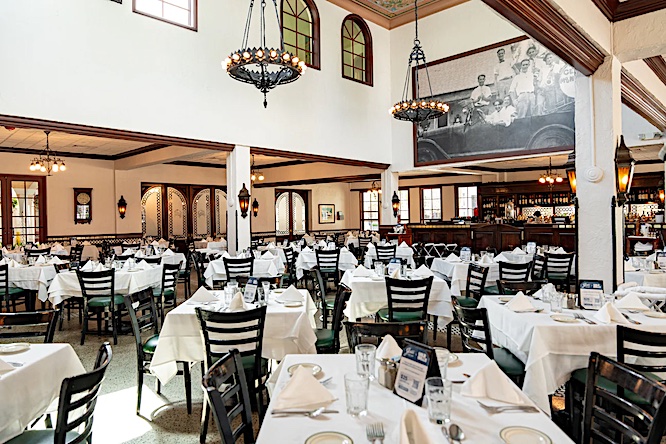
David ordered a caipirhiña for himself
and a Hemingway daiquiri for Katie.
“I suppose the thing to order here are
the stone crabs,” said David, “but I’m told
the side dishes are terrific, too, and we
should get the bisque and the conch fritters
to start with.”
The drinks arrived and the couple
clinked glasses and enjoyed the ice cold
cocktails before Katie told David what Sanchez
had said about Virginia Roberts.
“You know anyone in the TSA who could
track her down in Thailand?” she asked when
the starters arrived.
“Nobody down here, but up in New York,
yeah. He’s going to bitch about me not being
retired but—”
“—But you did him some favors when you
were working there.”
“I did,” said David. “Hey, these
fritters are terrific. Try one. I’ll call the
guy. Probably Terry knows someone down here
who had to stamp her passport if she left out
of Miami.”
“As well as stamp it if she came back.”
“Exactly. Oh, here come the stone
crabs.”
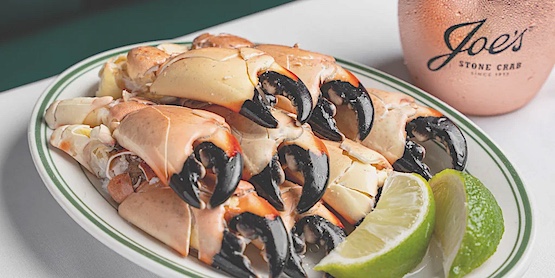 Set on a
platter with clarified butter and shell
crackers, with fried sweet potato chips and
cole slaw on the side, the stone crabs were
jumbos and full of sweet meat. David helped
crack them for Katie, and they enjoyed them
with a bottle of California Chardonnay.
Set on a
platter with clarified butter and shell
crackers, with fried sweet potato chips and
cole slaw on the side, the stone crabs were
jumbos and full of sweet meat. David helped
crack them for Katie, and they enjoyed them
with a bottle of California Chardonnay.
Both were delighted to have a night
away from the investigation but by the same
token looking forward to Monday morning when
they could proceed further.
The meal ended, David did tip the
maître d’ fifty bucks, and they drove back
across the Causeway to their hotel. Katie went
upstairs to go over the day’s notes, while
David went to his room to watch a basketball
game. The Knicks were playing the Heat. He put his
mobile phone on the night table then noticed a
small gift box tied with string on the bed. He
sat down, kicked off his loafers, picked up
the box, untied the string and opened it. Out
fell a very large black spider that moved
quickly towards him. David sprang back across
the room as the creature scuttled across the
bed. David picked up his shoe and slammed the
hairy body again and again, its insides
soaking the bed cover.
put his
mobile phone on the night table then noticed a
small gift box tied with string on the bed. He
sat down, kicked off his loafers, picked up
the box, untied the string and opened it. Out
fell a very large black spider that moved
quickly towards him. David sprang back across
the room as the creature scuttled across the
bed. David picked up his shoe and slammed the
hairy body again and again, its insides
soaking the bed cover.
David was breathing hard and sweating.
He picked up the phone and called Katie.
“Yeah, David, what’s up? Why are you
panting?”
“You remember that scene when James
Bond finds the tarantula in his bed?”
“Yeah, it was in Dr. No, wasn’t
it?”
“Yeah, well, I just met his brother.”
❖❖❖
THE WHITE WINES OF PORTUGAL
By John Mariani
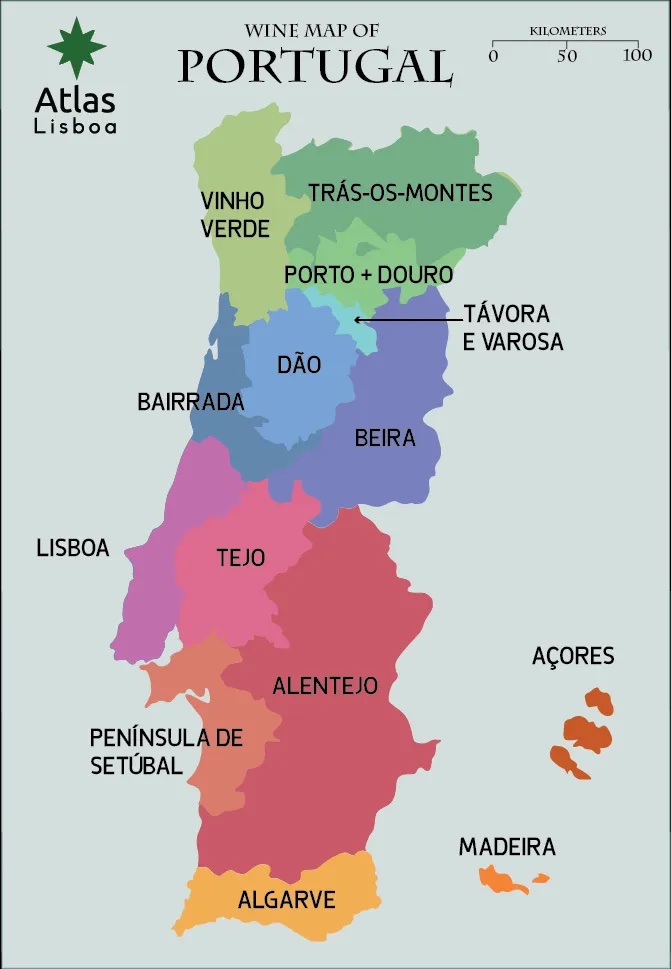
If
the casual wine drinker is at all familiar with
the wines of Portugal, it would definitely include
Port and Madeira and perhaps the red wines of the Dão
region. Few, I suspect, could identify any
Portuguese white wines, and up until the present
decade, there wasn’t much to say, especially since
so few were ever imported to the U.S.
Fifteen years ago nearly half of all the
country’s wines was produced by 90 co-operatives
using field blends––Portugal has 250 indigenous
varieties of grapes––but since then young winemakers
with good investors
have improved both red and white by using focused
varietal blocks. The Dao and Douro
regions are now known for its Tempranillo (Tinta
Roiz), while great strides are being made with the
white varietals Loureiro, Alvariñho, Bical and
Encruzada, with some of the best now trickling into
U.S. stores and on menus. The impetus for new
wineries to promote indigenous varietals rather than
still more Chardonnay and Cabernet, is all for the
good.
On a trip last month to Portugal I drank a
good number of reds (Tinto), but since the
country has such fabulous seafood, I largely stuck
with white (branco), and I was delighted to
be enlightened by so many first-rate examples.
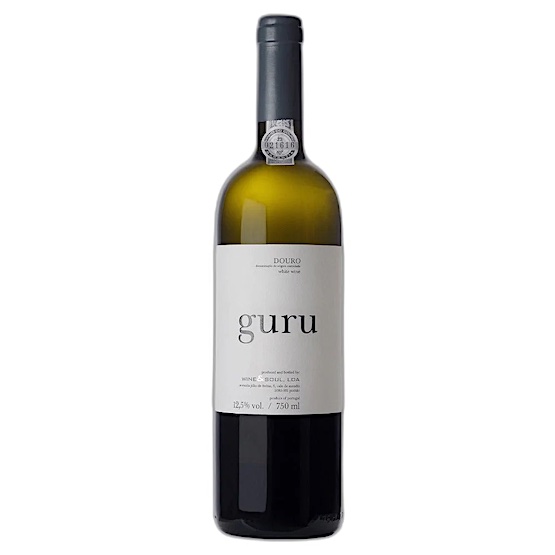 Wine & Soul Guru Douro 2023 ($45). One of the most
highly regarded brancos these days is
actually a field blend made by Sandra Tavares da
Silva and Jorge Serôdio Borges in Murça––primarily from
indigenous Viosinho, Rabigato, Códega do Larinho and
Gouveio, it is fermented and aged in French oak five
to eight month, so the minerality adds to the floral
elegance. The alcohol is a fine 12.5%.
Wine & Soul Guru Douro 2023 ($45). One of the most
highly regarded brancos these days is
actually a field blend made by Sandra Tavares da
Silva and Jorge Serôdio Borges in Murça––primarily from
indigenous Viosinho, Rabigato, Códega do Larinho and
Gouveio, it is fermented and aged in French oak five
to eight month, so the minerality adds to the floral
elegance. The alcohol is a fine 12.5%. 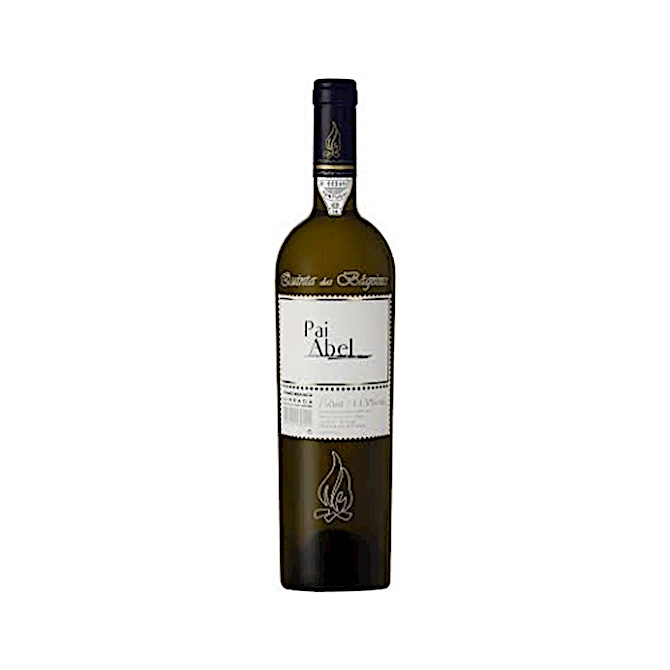
Quintas das
Bágeiras Pai Abel 2022 ($47) is a cuvée
by Mario Sergio Abel, whose family has been in the
business for three generations, from
well-pruned young and old vines, and this is a
particularly full-bodied white. Introduced in 1989,
the wines have become standards of the Bairrada
region, and newer wineries look to them for
inspiration. The wine is a blend of Maria Gomes and
Bical grapes that spend a year in old French
burgundy barrels. There is a dry fruit component and
excellent acidity.
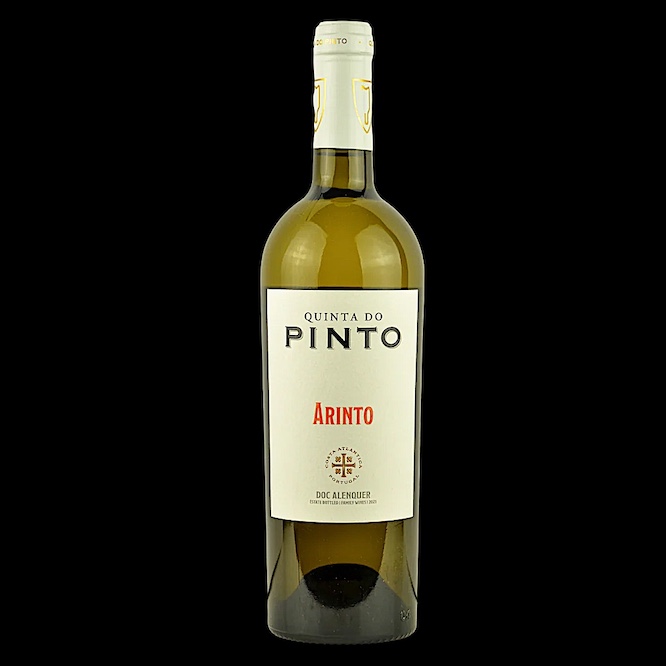 MMIX Quinta do Pinto 2023 ($14
) refers to the Roman numerals for 2009 the first
vintage bottled by the Cardoso Pinto family, whose
vineyards are north of Lisbon and close to the coast
so there is a maritime element. The wines are made
from local grapes, Fernão Pires and Viosinho, with
some Chardonnay and Arinto, in cement
take to preserve fruit and good acidity that makes
for what they call “Atlantic freshness.”
MMIX Quinta do Pinto 2023 ($14
) refers to the Roman numerals for 2009 the first
vintage bottled by the Cardoso Pinto family, whose
vineyards are north of Lisbon and close to the coast
so there is a maritime element. The wines are made
from local grapes, Fernão Pires and Viosinho, with
some Chardonnay and Arinto, in cement
take to preserve fruit and good acidity that makes
for what they call “Atlantic freshness.”
Quinta dos Carvalhais Encruzado 2023 ($26) comes from the
Dão,
produced by Sogrape (best known for Mateus rosé),
made from 100% Encruzado grapes, at 13% alcohol. It
shows plenty of fruit along with aromatic spices
that go so well with crustaceans and subtle
seasonings. Especially lovely matched with grilled
seafood.
($20).
Alvarinho, I believe, shows the best promise for
white wines of Portugal, and this one, from the far
north, has been made by the same family since 1982
and has taken on the name “classico” in that it
is a single varietal from
the Monção and Malgaço regions, in a micro-climate
with perfect rainfall, temperature and sunshine for
the grape with hot days and cold nights. This adds
complexity 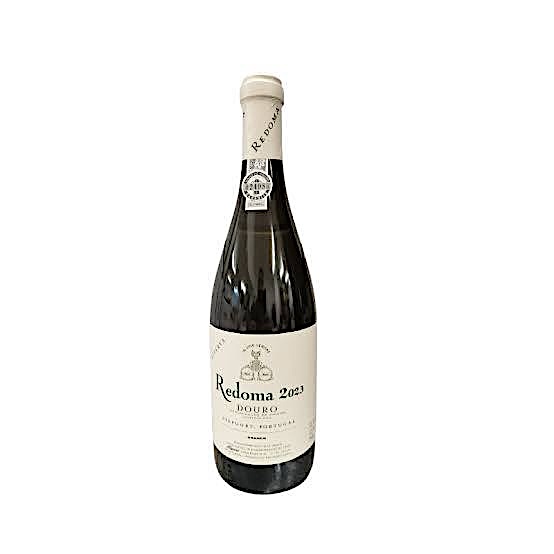 to the wine, much more
than old-fashioned Viñho Verdes used to back in the
last century when they were wines of a little
distinction.
to the wine, much more
than old-fashioned Viñho Verdes used to back in the
last century when they were wines of a little
distinction.
Niepoort
Redoma Reserva
2023 ($70) is
produced by the esteemed Port maker Niepoort. It’s a
high price for a branco, but its complexity
speaks for itself. Made in the Douro, the vineyards
are over 80 years old, but very high elevations
between 400 and 600 m. A blend of indigenous
varieties, primarily Rabigato, Códega, Viosinha and
Arinto, the wines are fermented in age for nine
months in Barricks to balance its high acidity.
There’s lots of citrus here and automatic herbs. The wine is said to age
well, but I tasted a
six-year-old vintage that had clearly begun
to oxidize.
The wine is said to age
well, but I tasted a
six-year-old vintage that had clearly begun
to oxidize.
Luis Pato Blanc de Blanc ($12) is a
well-priced sparkling
Blanc de Blanc from Bairrada, composed of 95% Maria Gomes and 5%
Sercialinho, separately fermented separately in
stainless steel vats for two weeks, with a second
fermentation in the bottle. It compares quite
favorably with many Spanish cavas or Italian
Proseccos as an apéritif.
❖❖❖
DEPT OF WRETCHED
EXCESS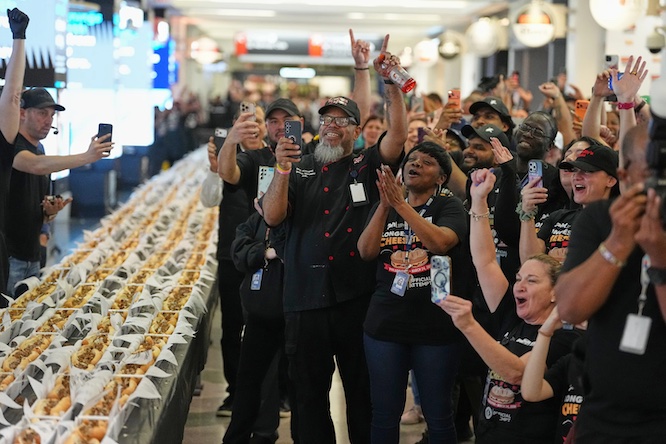
On National
Cheesesteak Day at Philadelphia Airport organizers
achieved a new Guinness World Record for the longest
line of cheesesteak sandwiches, with 1,291 lined up
inside a departure hall, far surpassing the previous
benchmark of 500 sandwiches.
❖❖❖
Any of John Mariani's books below may be ordered from amazon.com.
 The Hound in Heaven
(21st Century Lion Books) is a novella, and
for anyone who loves dogs, Christmas, romance,
inspiration, even the supernatural, I hope you'll find
this to be a treasured favorite. The story
concerns how, after a New England teacher, his wife and
their two daughters adopt a stray puppy found in their
barn in northern Maine, their lives seem full of promise.
But when tragedy strikes, their wonderful dog Lazarus and
the spirit of Christmas are the only things that may bring
his master back from the edge of despair.
The Hound in Heaven
(21st Century Lion Books) is a novella, and
for anyone who loves dogs, Christmas, romance,
inspiration, even the supernatural, I hope you'll find
this to be a treasured favorite. The story
concerns how, after a New England teacher, his wife and
their two daughters adopt a stray puppy found in their
barn in northern Maine, their lives seem full of promise.
But when tragedy strikes, their wonderful dog Lazarus and
the spirit of Christmas are the only things that may bring
his master back from the edge of despair. WATCH THE VIDEO!
“What a huge surprise turn this story took! I was completely stunned! I truly enjoyed this book and its message.” – Actress Ali MacGraw
“He had me at Page One. The amount of heart, human insight, soul searching, and deft literary strength that John Mariani pours into this airtight novella is vertigo-inducing. Perhaps ‘wow’ would be the best comment.” – James Dalessandro, author of Bohemian Heart and 1906.
“John Mariani’s Hound in Heaven starts with a well-painted portrayal of an American family, along with the requisite dog. A surprise event flips the action of the novel and captures us for a voyage leading to a hopeful and heart-warming message. A page turning, one sitting read, it’s the perfect antidote for the winter and promotion of holiday celebration.” – Ann Pearlman, author of The Christmas Cookie Club and A Gift for my Sister.
“John Mariani’s concise, achingly beautiful novella pulls a literary rabbit out of a hat – a mash-up of the cosmic and the intimate, the tragic and the heart-warming – a Christmas tale for all ages, and all faiths. Read it to your children, read it to yourself… but read it. Early and often. Highly recommended.” – Jay Bonansinga, New York Times bestselling author of Pinkerton’s War, The Sinking of The Eastland, and The Walking Dead: The Road To Woodbury.
“Amazing things happen when you open your heart to an animal. The Hound in Heaven delivers a powerful story of healing that is forged in the spiritual relationship between a man and his best friend. The book brings a message of hope that can enrich our images of family, love, and loss.” – Dr. Barbara Royal, author of The Royal Treatment.
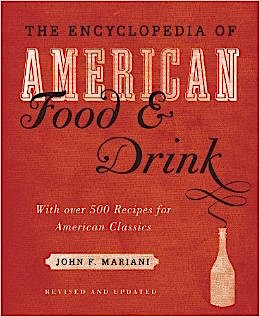 |
The Encyclopedia of American Food and Drink by John F. Mariani (Bloomsbury USA, $35) Modesty forbids me to praise my own new book, but let me proudly say that it is an extensive revision of the 4th edition that appeared more than a decade ago, before locavores, molecular cuisine, modernist cuisine, the Food Network and so much more, now included. Word origins have been completely updated, as have per capita consumption and production stats. Most important, for the first time since publication in the 1980s, the book includes more than 100 biographies of Americans who have changed the way we cook, eat and drink -- from Fannie Farmer and Julia Child to Robert Mondavi and Thomas Keller. "This book is amazing! It has entries for everything from `abalone' to `zwieback,' plus more than 500 recipes for classic American dishes and drinks."--Devra First, The Boston Globe. "Much needed in any kitchen library."--Bon Appetit. |
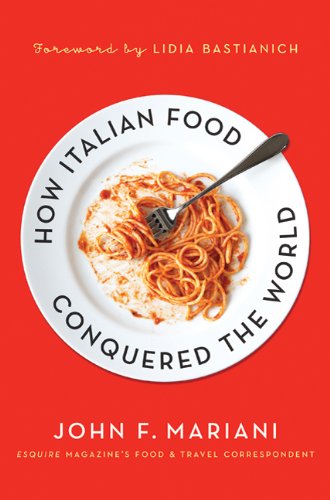
"Eating Italian will never be the same after reading John Mariani's entertaining and savory gastronomical history of the cuisine of Italy and how it won over appetites worldwide. . . . This book is such a tasteful narrative that it will literally make you hungry for Italian food and arouse your appetite for gastronomical history."--Don Oldenburg, USA Today. "Italian
restaurants--some good, some glitzy--far
outnumber their French rivals. Many of
these establishments are zestfully described
in How Italian Food Conquered the World, an
entertaining and fact-filled chronicle by
food-and-wine correspondent John F.
Mariani."--Aram Bakshian Jr., Wall Street
Journal.
"Equal parts
history, sociology, gastronomy, and just
plain fun, How Italian Food Conquered the
World tells the captivating and delicious
story of the (let's face it) everybody's
favorite cuisine with clarity, verve and
more than one surprise."--Colman Andrews,
editorial director of The Daily
Meal.com. "A fantastic and fascinating
read, covering everything from the influence
of Venice's spice trade to the impact of
Italian immigrants in America and the
evolution of alta cucina. This book will
serve as a terrific resource to anyone
interested in the real story of Italian
food."--Mary Ann Esposito, host of PBS-TV's
Ciao
Italia. "John Mariani has written the
definitive history of how Italians won their
way into our hearts, minds, and
stomachs. It's a story of pleasure over
pomp and taste over technique."--Danny Meyer,
owner of NYC restaurants Union Square
Cafe, The Modern, and Maialino.
|
 |
 |
 |
 |
 |
 |
MARIANI'S VIRTUAL GOURMET
NEWSLETTER is published weekly. Publisher: John Mariani. Editor: Walter Bagley. Contributing Writers: Christopher
Mariani, Misha Mariani, John A. Curtas, Gerry Dawes, Geoff Kalish.
Contributing
Photographer: Galina Dargery. Technical
Advisor: Gerry
McLoughlin.
If you wish to subscribe to this
newsletter, please click here: http://www.johnmariani.com/subscribe/index.html
© copyright John Mariani 2026